


Test Bank for Pnquiry into Physics 8th Edition by Vern Ostdiek – Ebook PDF Instant Download/Delivery: 8214345956 , 9798214345956
Full download Pnquiry into Physics 8th edition after payment
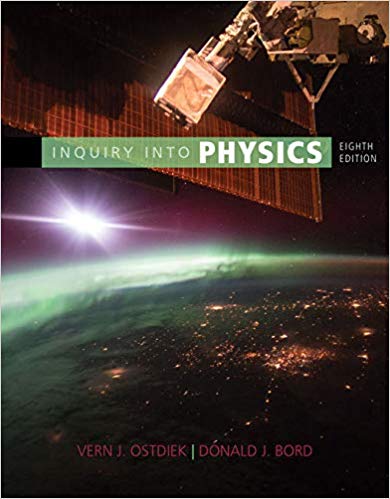
Product details:
ISBN 10: 8214345956
ISBN 13: 9798214345956
Author: Vern Ostdiek
What do iPods, GPS devices, airport metal detectors, LCD displays, and PET scans have to do with physics? The Eighth Edition of INQUIRY INTO PHYSICS answers these questions and many others, helping you understand fundamental concepts using a unique inquiry-based approach. The text integrates modern applications of physics such as plasma TVs and radar “guns” to demonstrate the relevance of physics in daily life.
Pnquiry into Physics 8th Table of contents:
Prologue. Getting Started
P.1. Introduction
P.2. Why Learn Physics?
P.3. What Is Physics?
P.4. How Is Physics Done?
P.5. How Does One Learn Physics?
P.6. Physical Quantities and Measurement
Commercial Applications. The Metric System: “For All Time, for All People.”
Chapter 1. The Study of Motion
1.1. Fundamental Physical Quantities
1.1a. Distance
1.1b. Time
1.1c. Mass
1.1d. Commercial Applications: Time Out!
1.2. Speed and Velocity
1.2a. Speed
1.2b. Velocity
1.2c. Vector Addition
1.3. Acceleration
1.3a. Centripetal Acceleration
1.4. Simple Types of Motion
1.4a. Constant Velocity
1.4b. Constant Acceleration
1.4c. More on Kinematics Graphs
1.4d. Profiles in Physics: Aristotle vs. Galileo
Summary
Important Equations
Mapping It Out!
Questions
Problems
Challenges
Chapter 2. Newton’s Laws
2.1. Force
2.1a. Weight
2.1b. Friction
2.1c. Engineering Applications: Friction: A Sticky Subject
2.2. Newton’s First Law of Motion
2.2a. Centripetal Force
2.3. Mass
2.4. Newton’s Second Law of Motion
2.4a. Force and Acceleration
2.4b. The International System of Units (SI)
2.5. Examples: Different Forces, Different Motions
2.5a. Projectile Motion Revisited
2.5b. Simple Harmonic Motion
2.5c. Falling Body with Air Resistance
2.5d. Mathematical Applications: Chaotic Dynamics
2.6. Newton’s Third Law of Motion
2.7. The Law of Universal Gravitation
2.7a. Orbits
2.7b. Gravitational Field
2.8. Tides
2.8a. Profiles in Physics: Isaac Newton
Summary
Important Equations
Mapping It Out!
Questions
Problems
Challenges
Chapter 3. Energy and Conservation Laws
3.1. Conservation Laws
3.2. Linear Momentum
3.2a. Newton’s Second Law, Revisited
3.2b. Conservation of Linear Momentum: Collisions
3.3. Work: The Key to Energy
3.3a. Work
3.3b. Different Forces, Different Work
3.4. Energy
3.4a. Mechanical Energy: Kinetic and Potential
3.4b. Other Forms of Potential Energy
3.5. The Conservation of Energy
3.5a. Applications of Energy Conservation
3.6. Collisions: An Energy Perspective
3.6a. Types of Collisions
3.6b. Noncontact Collisions
3.7. Power
3.7a. Environmental Applications: Exponential Growth and the Energy “Crisis”
3.8. Rotation and Angular Momentum
3.8a. Astronomical Application: Starquakes: A Glitch in Time
3.8b. Profiles in Physics: Archimedes of Syracuse: Engineering Physicist
Summary
Important Equations
Mapping It Out!
Questions
Problems
Challenges
Chapter 4. Physics of Matter
4.1. Matter: Phases, Forms, and Forces
4.1a. Phases of Matter
4.1b. Forms of Matter
4.1c. Behavior of Atoms and Molecules
4.1d. Lexicological Application: What’s in a Name?
4.2. Pressure
4.2a. Defining Pressure
4.2b. Gauge Pressure
4.3. Density
4.3a. Mass Density
4.3b. Weight Density and Specific Gravity
4.4. Fluid Pressure and Gravity
4.4a. The Law of Fluid Pressure
4.4b. Fluid Pressure in the Atmosphere
4.5. Archimedes’ Principle
4.5a. Buoyancy
4.5b. Archimedes’ Principle
4.5c. Applications of Archimedes’ Principle
4.5d. Low-Temperature Application: Superfluids: Friction-Free Flow
4.6. Pascal’s Principle
4.7. Bernoulli’s Principle
4.7a. Profiles in Physics: The Rise of the Modern Atomic Theory and the Development of Fluid Physics
Summary
Important Equations
Mapping It Out!
Questions
Problems
Challenges
Chapter 5. Temperature and Heat
5.1. Temperature
5.1a. Temperature Scales
5.1b. Temperature and Energy
5.1c. Atmospheric Science Applications: To Breathe or Not to Breathe, That Is the Question
5.2. Thermal Expansion
5.2a. Solids: Linear Expansion
5.2b. Liquids
5.2c. Gases: The Ideal Gas Law
5.3. The First Law of Thermodynamics
5.3a. Heat and Internal Energy
5.3b. The First Law of Thermodynamics
5.4. Heat Transfer
5.4a. Conduction
5.4b. Convection
5.4c. Radiation
5.4d. Combinations
5.4e. Astronomy Application: Energy Flow in Stars
5.5. Specific Heat Capacity
5.6. Phase Transitions
5.6a. Latent Heats
5.6b. Humidity
5.7. Heat Engines and the Second Law of Thermodynamics
5.7a. Heat Engines
5.7b. Heat Movers
5.7c. Usable Energy
5.7d. Profiles in Physics: Thermometry and Calorimetry
Summary
Important Equations
Mapping It Out!
Questions
Problems
Challenges
Chapter 6. Waves and Sound
6.1. Waves—Types and Properties
6.1a. Wave Types and Speed
6.1b. Amplitude, Wavelength, and Frequency
6.2. Aspects of Wave Propagation
6.2a. Wave Fronts and Rays
6.2b. Reflection
6.2c. Doppler Effect
6.2d. Bow Waves and Shock Waves
6.2e. Diffraction
6.2f. Interference
6.2g. Astronomy Applications: The Hubble Relation—Expanding Our Horizons
6.3. Sound
6.3a. Pressure Waves
6.3b. Sound Applications
6.3c. Meteorological Applications: Putting Sound to Work
6.4. Production of Sound
6.5. Propagation of Sound
6.5a. Reverberant Sound
6.5b. Reverberation Time
6.6. Perception of Sound
6.6a. Pitch
6.6b. Loudness
6.6c. Tone Quality
6.6d. Profiles in Physics: Acoustics Pioneers
Summary
Important Equations
Mapping It Out!
Questions
Problems
Challenges
Chapter 7. Electricity
7.1. Electric Charge
7.2. Electric Force and Coulomb’s Law
7.2a. Coulomb’s Law
7.2b. The Electric Field
7.2c. Meteorological Applications: Electrifying Sights and Sounds—A Thunderstorm Primer
7.3. Electric Currents—Superconductivity
7.3a. Electric Current
7.3b. Resistance
7.3c. Superconductivity
7.4. Electric Circuits and Ohm’s Law
7.4a. Voltage and Ohm’s Law
7.4b. Series and Parallel Circuits
7.4c. Medical Applications: Electricity and the Human Body
7.5. Power and Energy in Electric Currents
7.6. AC and DC
7.6a. Profiles in Physics: Founders of Electrical Science
Summary
Important Equations
Mapping It Out!
Questions
Problems
Challenges
Chapter 8. Electromagnetism and EM Waves
8.1. Magnetism
8.1a. Magnetic Materials and Fields
8.1b. Earth’s Magnetic Field
8.2. Interactions between Electricity and Magnetism
8.2a. Electromagnets
8.2b. Electric Motors
8.2c. Electromagnetic Induction and Electric Generators
8.3. Principles of Electromagnetism
8.4. Applications to Sound Reproduction
8.4a. Microphones and Magnetic Tape Devices
8.4b. Digital Sound
8.5. Electromagnetic Waves
8.5a. Radio Waves
8.5b. Microwaves
8.5c. Infrared
8.5d. Visible Light
8.5e. Ultraviolet Radiation
8.5f. X-Rays
8.5g. Gamma Rays
8.5h. Behavioral Sciences Application: N Rays – “C’est une erreur.”
8.6. Blackbody Radiation
8.6a. BBR Laws
8.6b. Temperature Measurement
8.6c. Detection of Warm Objects
8.6d. Astronomical Application: Cosmic Background Radiation (CBR)—A Relic of the Big Bang
8.7. EM Waves and Earth’s Atmosphere
8.7a. Ozone Layer
8.7b. Greenhouse Effect
8.7c. The Ionosphere
8.7d. Astronomy
8.7e. Profiles in Physics: 19th Century Leaders in Electromagnetism
Summary
Important Equations
Mapping It Out!
Questions
Problems
Challenges
Chapter 9. Optics
9.1. Light Waves
9.1a. Reflection
9.1b. Diffraction
9.1c. Interference
9.1d. Polarization
9.2. Mirrors: Plane and Not so Simple
9.2a. “One-Way Mirror”
9.2b. Curved Mirrors
9.2c. Astronomical Telescope Mirrors
9.3. Refraction
9.3a. The Law of Refraction
9.3b. Total Internal Reflection
9.4. Lenses and Images
9.4a. Image Formation
9.4b. Magnification
9.4c. Aberrations
9.4d. Optical Engineering Applications: Fresnel, Pharos, and Physics
9.5. The Human Eye
9.5a. Defects of the Eye
9.5b. Eye Surgery
9.6. Dispersion and Color
9.7. Atmospheric Optics: Rainbows, Halos, and Blue Skies
9.7a. Rainbows
9.7b. Halos
9.7c. Blue Skies
9.7d. Profiles in Physics: “On the Shoulders of Giants”
Summary
Important Equations
Mapping It Out!
Questions
Problems
Challenges
Chapter 10. Atomic Physics
10.1. The Quantum Hypothesis
10.1a. Blackbody Radiation
10.1b. Quantized Oscillators
10.2. The Photoelectric Effect and Photons
10.2a. Photoelectric Physics
10.2b. Applications of the Photoelectric Effect
10.3. Atomic Spectra
10.3a. Spectroscopic Applications: Cosmic Chemistry, “… to Dream of such a Thing.”
10.4. The Bohr Model of the Atom
10.4a. Atomic Spectra Explained
10.4b. Model Assumptions
10.5. Quantum Mechanics
10.5a. de Broglie’s Hypothesis
10.5b. The Bohr Atom Explained
10.6. Atomic Structure
10.6a. Atomic Energy Levels
10.6b. Some Applications
10.6c. The Pauli Exclusion Principle
10.7. X-Ray Spectra
10.8. Lasers
10.8a. Optical Applications: Holograms—3-D Images, No Glasses Required
10.8b. Profiles in Physics: The Solvay Conferences
Summary
Important Equations
Mapping It Out!
Questions
Problems
Challenges
Chapter 11. Nuclear Physics
11.1. The Nucleus
11.2. Radioactivity
11.2a. Alpha Decay
11.2b. Beta Decay
11.2c. Gamma Decay
11.2d. Radioactivity and Energy
11.2e. Applications
11.3. Half-Life
11.3a. Quantifying Half-Lives
11.3b. Radioactive Dating
11.3c. Medical Applications: Radiation: A Killer Turned Lifesaver
11.4. Artificial Nuclear Reactions
11.5. Nuclear Binding Energy
11.6. Nuclear Fission
11.6a. Atomic Bombs
11.6b. Nuclear Power Plants
11.6c. Power Plant Accidents
11.7. Nuclear Fusion
11.7a. Fusion in Stars
11.7b. Thermonuclear Weapons
11.7c. Controlled Fusion
11.7d. Cold Fusion
11.7e. Profiles in Physics: A Gallery of Nuclear Scientists
Summary
Important Equations
Mapping It Out!
Questions
Problems
Challenges
Chapter 12. Relativity, Particle Physics, and Cosmology
12.1. Special Relativity: The Physics of High Velocity
12.1a. Postulates of Special Relativity
12.1b. Predictions of Special Relativity
12.2. General Relativity
12.2a. Introduction
12.2b. Einstein’s Theory of General Relativity
12.2c. Motion in Curved Spacetime
12.3. Forces and Particles
12.3a. The Four Forces: Natural Interactions among Particles
12.3b. Classification Schemes for Particles
12.3c. Spin
12.3d. Elementary Particle Lexicon
12.4. Quarks: Order out of Chaos
12.4a. Quarks
12.5. The Standard Model and GUTs
12.5a. Quark Colors and Flavors
12.5b. Charm, Truth, and Beauty
12.5c. The Electroweak Interaction and GUTs
12.6. Cosmology
12.6a. Geometry, Dark Matter and Dark Energy
12.6b. The Inflationary Universe
12.6c. Astronomical Applications: Big Bang Nucleosynthesis
12.6d. Profiles in Physics: Murray Gell-Mann, Quark-atech
Summary
Important Equations
Mapping It Out!
Questions
Problems
Challenges
Appendix A. Winners of the Nobel Prize in Physics
Appendix B. Math Review
Table of Conversion Factors and Other Information
People also search for Pnquiry into Physics 8th :
inquiry into physics 8th edition pdf
inquiry into physics 8th edition answer key
inquiry into physics 8th edition pdf free
inquiry into physics 8th edition
inquiry into physics ostdiek/board 8th edition
Tags: Vern Ostdiek, Pnquiry into