


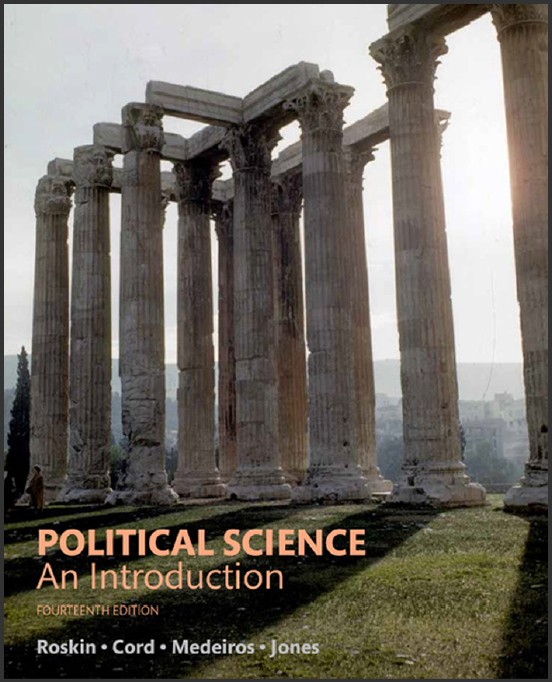
Test Bank for Political Science An Introduction 14th Edition by Michael Roskin, Robert Cord, James Medeiros, Walter Jones ISBN 0136598268 9780136598268
Original price was: $70.00.$35.00Current price is: $35.00.
Instant download (Test Bank) Political Science An Introduction 14th Edition Michael G. Roskin after payment
Test Bank for Political Science An Introduction 14th Edition by Michael Roskin, Robert Cord, James Medeiros, Walter Jones – Ebook PDF Instant Download/Delivery: 0136598268 , 9780136598268
Full download Political Science An Introduction 14th edition after payment
Product details:
ISBN 10: 0136598268
ISBN 13: 9780136598268
Author: Michael Roskin, Robert Cord, James Medeiros, Walter Jones
This is the eBook of the printed book and may not include any media, website access codes, or print supplements that may come packaged with the bound book. For courses in Introduction to Political Science Explore the fundamentals of Political Science Revel™ Political Science: An Introduction presents a survey of different political paradigms, viewpoints, and theories designed to encourage students to develop their own political views. Gearing their text toward those learning about the topic for the first time, authors Michael Roskin, Robert Cord, James Medeiros, and Walter Jones balance theoretical abstractions and applied reasoning to equip students with the knowledge to make calm, rational choices and protect themselves from political manipulation. The Updated 14th Edition offers coverage of many of the recent developments that have impacted politics in the U.S. and abroad, such as the rise of demagogic populism and the effects of social media on politics. Revel is Pearson’s newest way of delivering our respected content. Fully digital and highly engaging, Revel replaces the textbook and gives students everything they need for the course. Informed by extensive research on how people read, think, and learn, Revel is an interactive learning environment that enables students to read, practice, and study in one continuous experience — for less than the cost of a traditional textbook. NOTE: Revel is a fully digital delivery of Pearson content. This ISBN is for the standalone Revel access card. In addition to this access card, you will need a course invite link, provided by your instructor, to register for and use Revel.
Political Science An Introduction 14th Table of contents:
Part I The Bases of Politics
Chapter 1 Politics and Political Science
Learning Objectives
What Is Politics?
Political Power
Biological
Psychological
Cultural
Rational
Irrational
Power as a Composite
What Is Political Science?
The Master Science
Can Politics Be Studied as a Science?
The Struggle to See Clearly
Reasoned
Balanced
Supported with Evidence
Theoretical
What Good Is Political Science?
The Subfields of Political Science
Comparing Political Science to History and Journalism
Theory in Political Science
Behavioralism
New Institutionalism
Systems Theory
Rational-Choice Theory
“Political Theory” versus Theory in Political Science
The Normative Study of Politics
The Contractualists
Marxist Theories
Economics
Social Class
History
Chapter 1 in Review: Politics and Political Science
Review Questions
Key Terms
Further Reference
Chapter 2 Political Ideologies
Learning Objectives
What Is Ideology?
Liberalism
Modern Liberalism
Conservatism
Modern Conservatism
Socialism
Social Democracy
Communism
Imperialism
Organization
Maoism and Titoism
Nationalism
Fascism
Ideology in Our Day
The Collapse of Communism
Neoconservatism
Libertarianism
Feminism
Environmentalism
Is Ideology Finished?
Chapter 2 in Review: Political Ideologies
Review Questions
Key Terms
Further Reference
Chapter 3 States
Learning Objectives
Institutionalized Power
Effective, Weak, and Failed States
Unitary or Federal Systems
Unitary Systems
Devolution in Britain
Decentralization in France
Autonomy in Spain
Pros and Cons of Unitary Systems
Federal Systems
Pros and Cons of Federal Systems
Ex-soviet Federalism
Ex-yugoslav Federalism
Canadian Federalism
Electoral Systems
Single-Member Districts
Advantages of Single-Member Districts
Disadvantages of Single-Member Districts
Proportional Representation
Advantages of Proportional Representation
Disadvantages of Proportional Representation
States and the Economy
Chapter 3 in Review: States
Review Questions
Key Terms
Further Reference
Chapter 4 Constitutions and Rights
Learning Objectives
Constitutions
The Highest Law of the Land
The General Nature of Constitutional Law
Constitutions and Constitutional Government
The Purpose of a Constitution
A Statement of National Ideals
Formalizes the Structure of Government
Establishes the Legitimacy of Government
Can Constitutions Ensure Rights?
Civil Liberties and Civil Rights
Minority Groups and Civil Liberties
The Adaptability of the U.S. Constitution
The Right to Bear Arms
Freedom of Expression in the United States
Free Speech and Sedition
Twentieth-Century Sedition Acts
Rights for Terrorists?
Chapter 4 in Review: Constitutions and Rights
Review Questions
Key Terms
Further Reference
Chapter 5 Regimes
Learning Objectives
Representative Democracy
Popular Accountability of Government
Political Competition
Alternation in Power
Uncertain Electoral Outcomes
Popular Representation
Majority Decision
Right of Dissent and Disobedience
Political Equality
Popular Consultation
Free Press
Democracy in Practice: Elitism or Pluralism?
Totalitarianism
What Is Totalitarianism?
An All-Encompassing Ideology
A Single Party
Organized Terror
Monopoly of Communications
Monopoly of Weapons
Controlled Economy
Image and Reality of Total Control
Right-Wing Totalitarianism
Authoritarianism
Authoritarianism and the Developing Nations
The Democratization of Authoritarian Regimes
Chapter 5 in Review: Regimes
Review Questions
Key Terms
Further Reference
Part II Political Attitudes
Chapter 6 Political Culture
Learning Objectives
What Is Political Culture?
Political Culture and Public Opinion
Participation in America
The Decay of Political Culture
Elite and Mass Subcultures
Minority Subcultures
Political Socialization
The Agents of Socialization
The Family
The School
Peer Groups
The Mass Media
The Government
Chapter 6 in Review: Political Culture
Review Questions
Key Terms
Further Reference
Chapter 7 Public Opinion
Learning Objectives
What Public Opinion Is and Isn’t
The Shape of Public Opinion
Social Class
Education
Region
Religion
Age
Gender
Race and Ethnicity
Elite and Mass Opinion
Public-Opinion Polls
Polling Techniques
Sampling from a Population
Reaching the Sample
Asking the Questions
How Reliable Are the Polls?
American Opinion
Presidential Ratings
Liberals and Conservatives
Who Pays Attention?
Is Polling Fair?
Should the United States Be Governed by Polls?
Chapter 7 in Review: Public Opinion
Review Questions
Key Terms
Further Reference
Part III Political Interactions
Chapter 8 Political Communication
Learning Objectives
The Mass Media and Politics
Modern Mass Media
Newspapers
Radio
The News Services
The Elite Media
Social Media
The Giant: Television
Television News
Television and Politics
Nomination by Television
Television and Apathy
Television Ownership and Control
Are We Poorly Served?
What Can Be Done?
The Adversaries: Media and Government
Chapter 8 in Review: Political Communication
Review Questions
Key Terms
Further Reference
Chapter 9 Interest Groups
Learning Objectives
The Ubiquity of Interest Groups
Interest Groups and Political Parties
Goals
Nature of Memberships
Who Belongs to Interest Groups?
Interest Groups and Government
Government-Created Interest Groups
Bureaucrats as an Interest Group
Effective Interest Groups
The Rise of Big Money
The Rise of Single-Issue Groups
Size and Membership
Access
Interest-Group Strategies
Approaching Lawmakers
Approaching the Administration
Approaching the Judiciary
Appeals to the Public
Demonstrations
Violent Protest
Interest Groups: An Evaluation
Skewing Policy
Stalemating Political Power
Chapter 9 in Review: Interest Groups
Review Questions
Key Terms
Further Reference
Chapter 10 Parties
Learning Objectives
Functions of Parties
A Bridge Between People and Government
Aggregation of Interests
Integration into the Political System
Political Socialization
Mobilization of Voters
Organization of Government
Parties in Democracies
Centralization
Setting Government Policy
Party Participation in Government
Financing the Party
Classifying Political Parties
Communist Parties
Party Systems
Classifying Party Systems
One-Party Systems
Dominant-Party Systems
Two-Party Systems
Multiparty Systems
Two-Plus Party Systems
Fluid Party Systems
The Party System and the Electoral System
The Fragmentation of Party Systems
Chapter 10 in Review: Parties
Review Questions
Key Terms
Further Reference
Chapter 11 Elections
Learning Objectives
Why Do People Vote?
Who Votes?
Income and Education
Race
Age
Gender
Place of Residence
Who Votes How?
Partisan Identification
Class Voting
Regional Voting
Race and Ethnicity
Religious Blocs
Age Groups
Gender Gap
Marriage Gap
LGBTQ Gap
Urban Voting
Electoral Realignment
A New Realignment?
What Wins Elections?
Retrospective Voting
Candidate Strategies and Voter Groups
Chapter 11 in Review: Elections
Review Questions
Key Terms
Further Reference
Part IV Political Institutions
Chapter 12 Legislatures
Learning Objectives
The Origins of Parliaments
Presidential and Parliamentary Systems
Separation and Fusion of Powers
Advantages of Parliamentary Systems
Bicameral or Unicameral?
What Legislatures Do
The Committee System
A Closer Look at Legislatures
Lawmaking
Constituency Work
Supervision and Criticism of Government
Education
Representation
The Decline of Legislatures
Structural Disadvantages
Overspending
Incomprehensible Legislation
Lack of Expertise
Psychological Disadvantages
The Absentee Problem
Lack of Turnover
The Dilemma of Parliaments
Chapter 12 in Review: Legislatures
Review Questions
Key Terms
Further Reference
Chapter 13 Executives and Bureaucracies
Learning Objectives
Presidents and Prime Ministers
“Forming a Government” in Britain
Constructive No-Confidence in Germany
Cohabitation in France
The Presidentialization of Prime Ministers
Executive Terms
Executive Leadership
The Danger of Expecting Too Much
Cabinets
Who Serves in a Cabinet?
Bureaucracies
The United States
Communist Countries
France
Germany
Britain
Japan
The Trouble with Bureaucracy
Chapter 13 in Review: Executive and Bureaucracies
Review Questions
Key Terms
Further Reference
Chapter 14 Law and Politics
Learning Objectives
Types of Law
Criminal Law
Civil Law
Constitutional Law
Administrative Law
International Law
The Courts, the Bench, and the Bar
The U.S. Court System
The National Court Structure
The State Court System
Judges
Federal Judges
State Judges
Comparing Courts
The Anglo-American Adversarial and Accusatorial Process
British Courts
Selection and Tenure of Judges
The Lawyer’s Role
European Court Systems
The European Inquisitorial Process
The Lawyer’s Role
Courts in Russia
The Role of the Courts
The U.S. Supreme Court
The Supreme Court’s Political Role
The Views of Justices
The Supreme Court’s Political Impact
Civil Rights
Criminal Procedure
Legislative Reapportionment
The Post-Warren Courts
The Rise of the Originalists
Chapter 14 in Review: Law and Politics
Review Questions
Key Terms
Further Reference
Part V What Political Systems Do
Chapter 15 Political Economy
Learning Objectives
What Is Political Economy?
Government and the Economy
Inflation
Tax Hike
Balance of Payments
Floating the Dollar
Wage-Price Freeze
Oil Shocks
Stagflation
Interest Rates
Tax Cuts
Budget Deficits
Trade Deficits
Government Debt
Fiscal Cliff
Inequality
Bubbles
What is Poverty?
Welfare versus Entitlements
The Costs of Welfare
Food Stamps
Welfare Reform
Healthcare Reform
How Big Should Government Be?
Chapter 15 in Review: Political Economy
Review Questions
Key Terms
Further Reference
Chapter 16 Violence and Revolution
Learning Objectives
System Breakdown
Violence as a Symptom
Types of Violence
Primordial
Separatist
Revolutionary
Coups
Issues
Change as a Cause of Violence
Terrorism
Revolutions
Intellectuals and Revolution
The Stages of Revolution
The Old Regime Decays
The First Stage of Revolution
At First, Moderates Take Over
The Extremists Take Over
A “Thermidor” ends The Reign of Terror
After the Revolution
Chapter 16 in Review: Revolution and Violence
Review Questions
Key Terms
Further Reference
Chapter 17 International Relations
Learning Objectives
What Is International Relations?
Power and National Interest
The Importance of Economics
Why War?
Micro Theories
Macro Theories
Balance of Power
Hierarchy of Power
Misperception
Keeping Peace
World Government
Collective Security
Functionalism
Third-Party Assistance
Diplomacy
Peacekeeping
Beyond Sovereignty?
The United Nations
The North Atlantic Treaty Organization
U.S. Foreign Policy: Involved or Isolated?
Cycles of U.S. Foreign Policy
The United States in a Dangerous World
Chapter 17 in Review: International Relations
Review Questions
Key Terms
Further Reference
Glossary
Index
People also search for Political Science An Introduction 14th :
political science an introduction 14th edition quizlet
political science an introduction updated edition 14th edition
political science an introduction 14th ed
political science main topics
political science essay topics
Tags: Michael Roskin, Robert Cord, James Medeiros, Walter Jones, Political Science, An Introduction