


Test Bank for Principles of Microeconomics 8th Edition by Gregory Mankiw – Ebook PDF Instant Download/Delivery: 1305971493, 9781305971493
Full download Principles of Microeconomics 8th edition after payment
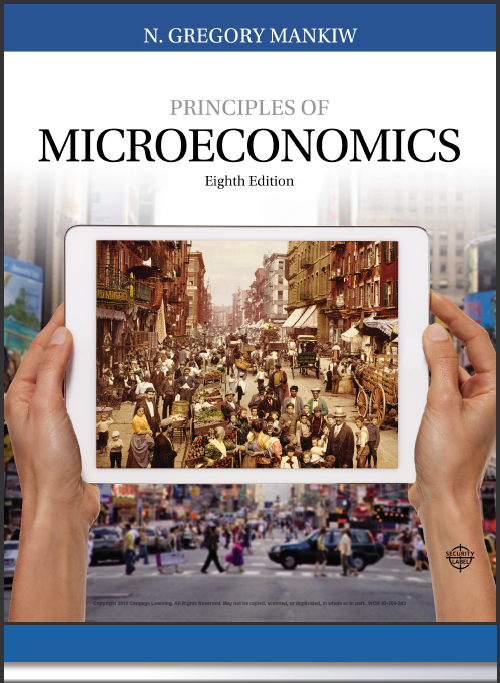
Product details:
ISBN 10: 1305971493
ISBN 13: 9781305971493
Author: Gregory Mankiw
Now you can master the principles of microeconomics with the help of the most popular, widely-used economics textbook by students worldwide — Mankiw’s PRINCIPLES OF MICROECONOMICS, 8E. With its clear and engaging writing style, this book emphasizes only the material that will help you better understand the world in which you live, will make you a more astute participant in the economy, and will give you a better understanding of both the potential and limits of economic policy. The latest relevant examples bring microeconomic principles to life. Acclaimed text author N. Gregory Mankiw explains, “”I have tried to put myself in the position of someone seeing economics for the first time. My goal is to emphasize the material that students should and do find interesting about the study of the economy.”” The powerful MindTap student-focused digital resource is available and sold separately. Its digital learning and homework solutions reinforce the principles presented in this edition.
Principles of Microeconomics 8th Table of contents:
Part I. Introduction
Chapter 1. Ten Principles of Economics
How People Make Decisions
-
Principle 1: People Face Trade-Offs
-
Principle 2: The Cost of Something Is What You Give Up to Get It
-
Principle 3: Rational People Think at the Margin
-
Principle 4: People Respond to Incentives
How People Interact
-
Principle 5: Trade Can Make Everyone Better Off
-
Principle 6: Markets Are Usually a Good Way to Organize Economic Activity
-
Principle 7: Governments Can Sometimes Improve Market Outcomes
How the Economy as a Whole Works
-
Principle 8: A Country’s Standard of Living Depends on Its Ability to Produce Goods and Services
-
Principle 9: Prices Rise When the Government Prints Too Much Money
-
Principle 10: Society Faces a Short-Run Trade-Off Between Inflation and Unemployment
Conclusion
-
Chapter QuickQuiz
-
Summary
-
Key Concepts
-
Questions for Review
-
Problems and Applications
Chapter 2. Thinking Like an Economist
The Economist as Scientist
-
The Scientific Method: Observation, Theory, and More Observation
-
The Role of Assumptions
-
Economic Models
-
The Circular-Flow Diagram
-
The Production Possibilities Frontier
-
Microeconomics and Macroeconomics
The Economist as Policy Adviser
-
Positive vs. Normative Analysis
-
Economists in Washington
-
Why Economists Disagree: Scientific Judgments, Values, Perception vs. Reality
Let’s Get Going
-
Chapter QuickQuiz
-
Summary
-
Key Concepts
-
Questions for Review
-
Problems and Applications
Chapter 3. Interdependence and the Gains from Trade
-
A Parable for the Modern Economy
-
Production Possibilities
-
Specialization and Trade
-
Comparative vs. Absolute Advantage
-
Opportunity Cost
-
Comparative Advantage and Trade
-
The Price of the Trade
-
Applications: Serena Williams & U.S. Trade Policy
-
Conclusion
-
Chapter QuickQuiz
-
Summary
-
Key Concepts
-
Questions for Review
-
Problems and Applications
Part II. How Markets Work
Chapter 4. The Market Forces of Supply and Demand
-
Markets and Competition
-
Demand: Curves, Shifts, and Market Demand
-
Supply: Curves, Shifts, and Market Supply
-
Supply and Demand Together: Equilibrium
-
Analyzing Changes in Equilibrium
-
Conclusion: How Prices Allocate Resources
-
Chapter QuickQuiz
-
Summary
-
Key Concepts
-
Questions for Review
-
Problems and Applications
Chapter 5. Elasticity and Its Application
-
Elasticity of Demand
-
Computing Elasticities (Midpoint Method)
-
Elasticity and Total Revenue
-
Elasticity of Supply
-
Applications: Farming, OPEC, Drug Interdiction
-
Conclusion
-
Chapter QuickQuiz
-
Summary
-
Key Concepts
-
Questions for Review
-
Problems and Applications
Chapter 6. Supply, Demand, and Government Policies
-
Controls on Prices: Ceilings and Floors
-
Taxes: On Sellers and Buyers
-
Elasticity and Tax Incidence
-
Conclusion
-
Chapter QuickQuiz
-
Summary
-
Key Concepts
-
Questions for Review
-
Problems and Applications
Part III. Markets and Welfare
Chapter 7. Consumers, Producers, and the Efficiency of Markets
-
Consumer Surplus
-
Producer Surplus
-
Market Efficiency
-
Evaluating Market Equilibrium
-
Conclusion: Efficiency vs. Market Failure
-
Chapter QuickQuiz
-
Summary
-
Key Concepts
-
Questions for Review
-
Problems and Applications
Chapter 8. Application: The Costs of Taxation
-
Deadweight Loss of Taxation
-
Determinants of DWL
-
Tax Revenue and DWL
-
Conclusion
-
Chapter QuickQuiz
-
Summary
-
Key Concepts
-
Questions for Review
-
Problems and Applications
Chapter 9. Application: International Trade
-
Determinants of Trade
-
Winners and Losers from Trade
-
Effects of Tariffs
-
Arguments For and Against Trade Restrictions
-
Conclusion
-
Chapter QuickQuiz
-
Summary
-
Key Concepts
-
Questions for Review
-
Problems and Applications
Part IV. The Economics of the Public Sector
Chapter 10. Externalities
-
Market Inefficiency from Externalities
-
Public Policies: Regulations, Taxes, Permits
-
Private Solutions and the Coase Theorem
-
Conclusion
-
Chapter QuickQuiz
-
Summary
-
Key Concepts
-
Questions for Review
-
Problems and Applications
Chapter 11. Public Goods and Common Resources
-
Public vs. Private Goods
-
The Free-Rider Problem
-
The Tragedy of the Commons
-
Role of Property Rights
-
Conclusion
-
Chapter QuickQuiz
-
Summary
-
Key Concepts
-
Questions for Review
-
Problems and Applications
Chapter 12. The Design of the Tax System
-
Overview of U.S. Taxes
-
Efficiency and Equity in Taxation
-
Marginal vs. Average Tax Rates
-
Tax Incidence and Policy Design
-
Conclusion
-
Chapter QuickQuiz
-
Summary
-
Key Concepts
-
Questions for Review
-
Problems and Applications
Part V. Firm Behavior and the Organization of Industry
Chapter 13. The Costs of Production
-
Total Revenue, Cost, and Profit
-
Opportunity Costs
-
Cost Curves and Economies of Scale
-
Short-Run vs. Long-Run Costs
-
Conclusion
-
Chapter QuickQuiz
-
Summary
-
Key Concepts
-
Questions for Review
-
Problems and Applications
Chapter 14. Firms in Competitive Markets
-
Characteristics of Competitive Markets
-
Profit Maximization and Firm’s Supply
-
Entry/Exit Decisions
-
Long-Run Market Supply
-
Conclusion
-
Chapter QuickQuiz
-
Summary
-
Key Concepts
-
Questions for Review
-
Problems and Applications
Chapter 15. Monopoly
-
Why Monopolies Arise
-
Monopoly Pricing and Output
-
Deadweight Loss and Price Discrimination
-
Public Policy Toward Monopolies
-
Conclusion
-
Chapter QuickQuiz
-
Summary
-
Key Concepts
-
Questions for Review
-
Problems and Applications
Chapter 16. Monopolistic Competition
-
Product Differentiation
-
Short-Run and Long-Run Equilibrium
-
Advertising and Brand Names
-
Conclusion
-
Chapter QuickQuiz
-
Summary
-
Key Concepts
-
Questions for Review
-
Problems and Applications
Chapter 17. Oligopoly
-
Game Theory and the Prisoners’ Dilemma
-
Cooperation vs. Self-Interest
-
Antitrust Policy
-
Conclusion
-
Chapter QuickQuiz
-
Summary
-
Key Concepts
-
Questions for Review
-
Problems and Applications
Part VI. The Economics of Labor Markets
Chapter 18. The Markets for the Factors of Production
-
Demand and Supply of Labor
-
Equilibrium in Factor Markets
-
Capital and Land
-
Conclusion
-
Chapter QuickQuiz
-
Summary
-
Key Concepts
-
Questions for Review
-
Problems and Applications
Chapter 19. Earnings and Discrimination
-
Wage Determinants
-
Human Capital, Signaling, and Discrimination
-
Minimum Wages, Unions, Efficiency Wages
-
Conclusion
-
Chapter QuickQuiz
-
Summary
-
Key Concepts
-
Questions for Review
-
Problems and Applications
Chapter 20. Income Inequality and Poverty
-
Measuring Inequality
-
Theories of Redistribution
-
Policy Approaches
-
Conclusion
-
Chapter QuickQuiz
-
Summary
-
Key Concepts
-
Questions for Review
-
Problems and Applications
Part VII. Topics for Further Study
Chapter 21. The Theory of Consumer Choice
-
Budget Constraints and Preferences
-
Indifference Curves and Optimization
-
Income and Substitution Effects
-
Applications: Wages, Saving, and Demand Curves
-
Conclusion
-
Chapter QuickQuiz
-
Summary
-
Key Concepts
-
Questions for Review
-
Problems and Applications
Chapter 22. Frontiers of Microeconomics
-
Asymmetric Information
-
Political Economy
-
Behavioral Economics
-
Conclusion
-
Chapter QuickQuiz
-
Summary
-
Key Concepts
-
Questions for Review
-
Problems and Applications
Module 3. The Economics of Healthcare
-
Special Characteristics of the Healthcare Market
-
Externalities
-
Quality Monitoring
-
Insurance Market Imperfections
-
Healthcare as a Right
-
Marketplace Rules
-
-
Key Facts about the Healthcare System
-
Longevity
-
Spending Growth
-
U.S. Healthcare Costs
-
Out-of-Pocket Spending Trends
-
-
Conclusion: The Policy Debate
-
Key Concepts
-
Questions for Review
Study Guides
(Each Chapter Includes: Overview, Review, Helpful Hints, Terms, Questions, Self-Test, Advanced Critical Thinking)
-
Ch 1: Ten Principles of Economics
-
Ch 2: Thinking Like an Economist
-
Ch 3: Interdependence and the Gains from Trade
-
Ch 4: The Market Forces of Supply and Demand
-
Ch 5: Elasticity and Its Application
-
Ch 6: Supply, Demand, and Government Policies
-
Ch 7: Consumers, Producers, and the Efficiency of Markets
-
Ch 8: The Costs of Taxation
-
Ch 9: International Trade
-
Ch 10: Externalities
-
Ch 11: Public Goods and Common Resources
-
Ch 12: The Design of the Tax System
-
Ch 13: The Costs of Production
-
Ch 14: Firms in Competitive Markets
-
Ch 15: Monopoly
-
Ch 16: Monopolistic Competition
-
Ch 17: Oligopoly
-
Ch 18: The Markets for the Factors of Production
-
Ch 19: Earnings and Discrimination
-
Ch 20: Income Inequality and Poverty
-
Ch 21: The Theory of Consumer Choice
-
Ch 22: Frontiers of Microeconomics
People also search for Principles of Microeconomics 8th:
gregory mankiw principles of microeconomics 8th edition
principles of microeconomics 8th edition solutions pdf
principles of microeconomics 8th edition pdf reddit
principles of microeconomics 8th edition mankiw
principles of microeconomics 8th canadian edition pdf
Tags: Gregory Mankiw, Principles of Microeconomics