


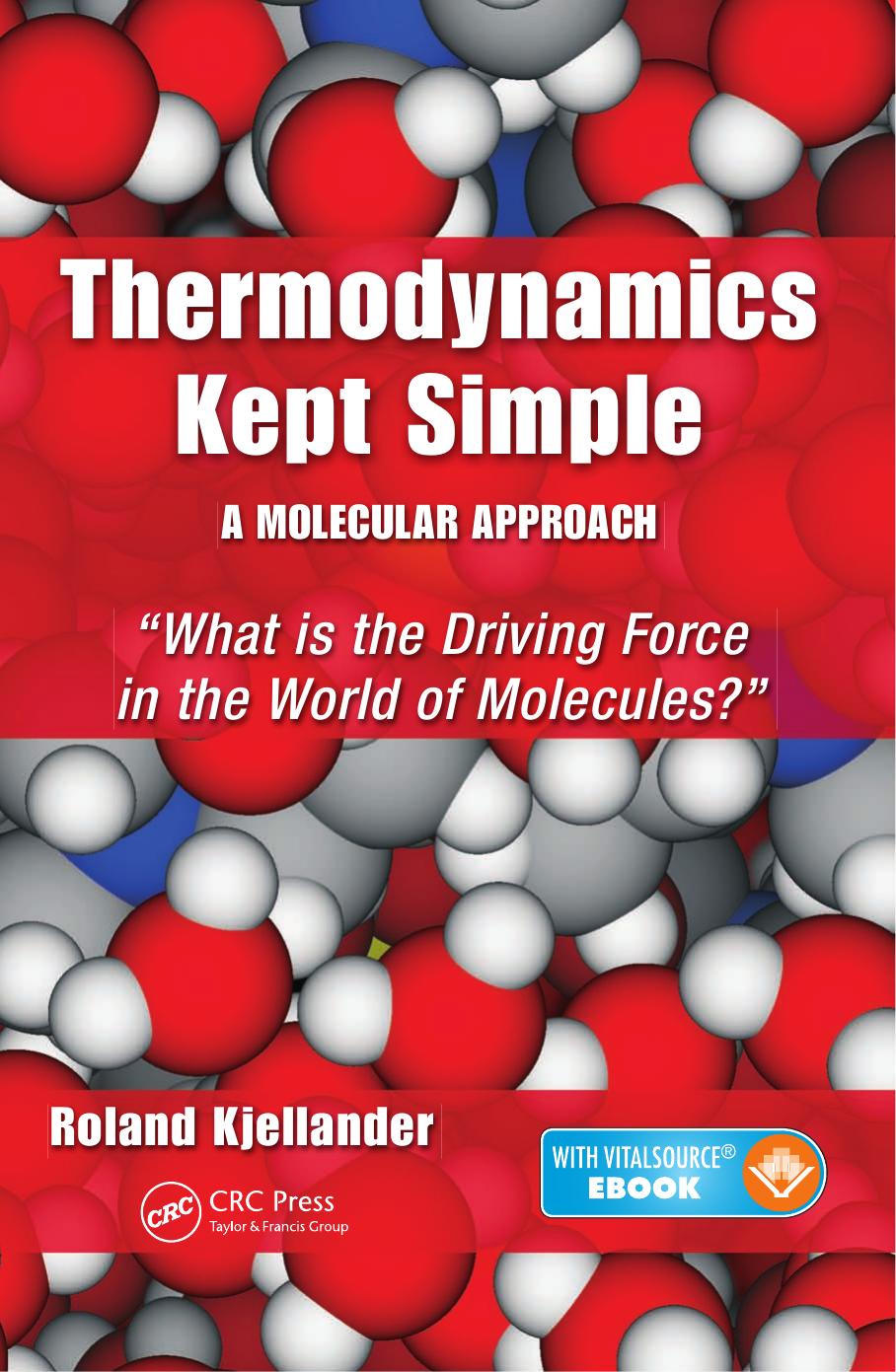
Thermodynamics kept simple a molecular approach what is the driving force in the world of molecules 1st edition by Roland Kjellander ISBN 1482244120 9781482244120
Original price was: $70.00.$35.00Current price is: $35.00.
Instant download Thermodynamics kept simple a molecular approach what is the driving force in the after payment
Thermodynamics kept simple a molecular approach what is the driving force in the world of molecules 1st edition by Roland Kjellander – Ebook PDF Instant Download/Delivery: 1482244120 , 9781482244120
Full download Thermodynamics kept simple a molecular approach what is the driving force in the world of molecules 1st edition after payment
Product details:
ISBN 10: 1482244120
ISBN 13: 9781482244120
Author: Roland Kjellander
Thermodynamics Kept Simple – A Molecular Approach: What is the Driving Force in the World of Molecules? offers a truly unique way of teaching and thinking about basic thermodynamics that helps students overcome common conceptual problems. For example, the book explains the concept of entropy from the perspective of probabilities of various molecula
Thermodynamics kept simple a molecular approach what is the driving force in the world of molecules 1st Table of contents:
CHAPTER 1 Introduction
CHAPTER 2 Energy and entropy
2.1 In the world of molecules Movements, interactions, and energy
Figure 2.1 The distribution of molecular speeds at various temperatures for molecules of the same mass. The curves show the proportion of molecules that have a certain speed.
Key points
2.2 Self-evident matters? Spreading and spontaneity
Figure 2.2 A box with a partition that prevents the particles in the left part from reaching the right part, which is empty.
Figure 2.3 All particles are located in the left part of the box immediately after the removal of the partition, but then they spread evenly throughout the whole volume.
Figure 2.4 (a) A box with one kind of particles at one side of a partition and particles of another kind at the other side. The partition prevents the particles from reaching the opposite part of the box. (b) The two kinds of particles are found in the respective part of the box immediately after the partition has been removed, but then they spread evenly throughout the volume.
2.3 Particle locations Macroscopic and microscopic states
Figure 2.5 A snapshot picture of the particles in a box. We can observe on which places the various particles are, i.e., what configuration they have.
Figure 2.6 A particle configuration is determined by taking note of in which cells the particles are located. The position of the respective particle within each cell does not matter.
Figure 2.7 Some possible particle configurations. Each of these is equally likely for an ideal gas.
Figure 2.8 A system with one particle and six cells has six possible configurations, Ω = 6.
Figure 2.9 A system with two particles and six cells has 36 possible configurations, Ω = 62.
Figure 2.10 A system with three particles and six cells has 216 possible configurations, Ω = 63.
Figure 2.11 Sixty particles are trapped in the left part of a box. The partition prevents them from entering the right part, which is empty.
Figure 2.12 The particles spread throughout the volume when the partition is removed, i.e., the gas expands spontaneously.
Key points
2.4 Two independent systems The concept of entropy
Figure 2.13 Two systems A and B.
Figure 2.14 The combined system AB.
Figure 2.15 The combined system AB has ΩAB = 4 × 3 states.
Key points
2.5 Gas diffusion Mixing gases
Figure 2.16 The system in Figure 2.4a is divided into imagined cells. The partition divides the box into two equal halves.
Figure 2.17 The two particle types spread throughout the entire volume in Figure (a) ŕ (c).
Key points
2.6 Dispersion of energy Energy distribution and entropy
Figure 2.18 (a) Particle in its ground state (the lowest possible energy). (b) Particle in its second excited quantum state, which has a higher energy.
Figure 2.19 The initial state for the system with four particles.
Figure 2.20 It is equally likely that any of the particles is in its sixth excited quantum state.
Figure 2.21 Some of the possible energy distributions where a particle is in its fourth and another in its second excited quantum state.
Figure 2.22 All microstates of a system where one particle is in the third, one in the second, one in the first excited quantum state, and one is in the ground state. The numbers at the top refer to the states depicted in the first line.
Figure 2.23 A more realistic example in which each particle has several quantum states at each energy level. Each particle can be in any of its quantum states in an energy level, which are considered as distinct possibilities that all count. Here we show just four of the possibilities – they have the first particle in different quantum states at the fourth energy level above the ground state.
Key points
2.7 Hotter and colder The concept of temperature; the second and third laws of thermodynamics
Figure 2.24 Spontaneous heat transfer between two systems A and B. The system that delivers heat to the other has the highest temperature by definition.
Figure 2.25 The entropy as a function of energy of the systems A and B depicted in Figure 2.24. The figure shows the change in the macroscopic state of the systems when heat is transferred spontaneously from system B to A. System A receives the amount of heat q and B gives away the same amount. System A goes from its state to state whereby its energy increases by the amount q and its entropy increases by ΔSA. At the same time B goes from its state to whereby its energy is reduced by the amount q and its entropy changes by ΔSB, which is negative.
Figure 2.26 A sketch of cigar-shaped molecules in a liquid crystal. The figure shows a typical snapshot picture of the mutual orientations of the molecules. They have their longitudinal axes approximately parallel and exhibit a relatively orderly phase with higher entropy than the corresponding disordered phase where the axes are more randomly oriented.
Key points
2.8 Availability of energy*47 The Boltzmann factor
Figure 2.27 A system (A) that has a free heat exchange with its surroundings (B), which has temperature T. If B is much greater than A, the temperature will not be appreciably affected by the exchange of heat and remains constant. At thermal equilibrium A also has temperature T.
Key points*
CHAPTER 3 Entropy and free energy
3.1 Poorly soluble substance Particle locations and energy
Figure 3.1 A poorly soluble substance at the bottom of a beaker filled with solvent. The white dots represent solute molecules that are tremendously exaggerated in size.
Figure 3.2 The upper figure shows a poorly soluble solid (white rectangle) in contact with a solvent (gray region). The white circles are solute molecules. The middle figure shows a magnified view of the framed area in the upper figure. This figure is rotated 90 degrees relative to the upper. In this example the energy is lower when the molecules of the substance are in the solid phase than when they are surrounded by solvent molecules. This is represented by the curve in the plot labeled “Energy.” The energy has a low value to the left compared to the value at the place where the molecule is located in the figure (marked with a cross on the energy curve). The region where the energy is low is called a potential well.
Figure 3.3 The molecule binds to the solid phase – it “goes down” into the potential well – whereby energy is released.
3.2 Evaporation of a liquid drop Balance between entropy and energy; vapor pressure
Figure 3.4 A closed box with a drop of liquid on the bottom. The box is filled with nitrogen gas that does not dissolve appreciably in the liquid.
Figure 3.5 For a molecule to be able to leave the liquid phase, energy is required.
Figure 3.6 Attractive interactions between molecules in liquid. This attraction keeps the molecules together as a liquid.
Key points
3.3 Combustion of magnesium Exothermic reaction with loss of Sconf
Figure 3.7 Schematic energy diagram for the reaction 2 Mg(s) + O2(g) ŕ 2 MgO(s). Magnesium can combine with oxygen after ignition, whereby the energy barrier is overcome, i.e., the energy maximum between the reactants and the products. The resulting magnesium oxide has a lower energy; the energy difference between the product and the reactants is ΔU, which is negative. The released energy is used partially to ignite further Mg whereby the reaction proceeds.
Figure 3.8 During the combustion of magnesium, oxygen is bound and magnesium oxide (MgO) is formed. Thereby the energy, that was stored in the reactants before the reaction, is released.
3.4 Burning candle Exothermic reaction with gain in Sconf
Figure 3.9 A candle containing stearic acid.
Figure 3.10 During the combustion of stearic acid, energy is released that initially was stored in the reactants. In the reaction, 26 oxygen molecules are consumed per stearic acid molecule and 36 gas molecules are formed (half of them are shown in the figure).
Key points
3.5 It gets cold Endothermic reaction
Figure 3.11 Schematic energy diagram for the reaction between the solids barium hydroxide and ammonium nitrate. The products are solid barium nitrate and an aqueous solution of ammonia. The energy difference ΔU between the products and reactants is positive, so energy is taken from the surroundings during the reaction.
Key points
3.6 Colloidal stability Repulsion driven by entropy
Figure 3.12 Example of colloidal dispersion where the surfaces of the colloidal particles are negatively charged and where positive ions exist in the surrounding aqueous solution.
Figure 3.13 Enlarged sketch of the gap between two neighboring particles and parts of the surfaces. The positive ions are bound to the surfaces of the particles when they are in dry condition.
Figure 3.14 The ions detach from the surfaces when the particles are dispersed in water.
Figure 3.15 A sketch of the ion concentration in the gap between the surfaces of the particles.
Figure 3.16 Upon an increase of the distance between the surfaces the configurational entropy of the ions increases. This entropy increase manifests itself as a repulsive force between the surfaces.
Key points
3.7 What is the driving force? Total entropy of the system and the surroundings
Key points
3.8 To indirectly keep track of the surroundings The concept of free energy
Figure 3.17 A system in contact with a thermostat obtains constant temperature when heat is freely exchanged between the system and the thermostat.
Figure 3.18 A process at constant temperature and volume can occur spontaneously in the direction of decreasing free energy A (Helmholtz energy). Thereby, the total entropy Stot of the system and the surroundings increases. Equilibrium is reached when A has reached its minimal value and at the same time Stot is as large as possible under the given circumstances. At the minimum and the maximum point, respectively, the derivative is zero (horizontal line) and dA = 0 and dStot = 0, respectively.
Key points
CHAPTER 4 More on gases and the basics of thermodynamics
4.1 Bike pumps and fridges Gas compression, pressure, and work
Figure 4.1 A schematic diagram of a refrigerator. Liquid refrigerant passes out through a narrow valve (throttle valve) and vaporizes (A). The heat required for vaporization is taken from the refrigerator’s interior. The steam enters (B) into a compressor (C) where its temperature is raised greatly during compression. The hot steam is cooled (D) in a heat exchanger outside the fridge and is condensed into liquid that is returned (E) to the throttle valve.
Figure 4.2 A cylinder that is sealed by a freely movable piston, which is assumed to run without any friction. The cross-sectional area of the cylinder and the piston is a. The device is located in an evacuated box. The cylinder contains a gas. The volume of the gas can be changed by moving the piston inwards or outwards. The piston is held at the desired position by the application of a suitably large force F on the exterior side of the piston. When F is increased the gas is compressed and when F is reduced it expands.
Figure 4.3 A molecule colliding with the surface of a much heavier body changes the direction of its velocity.
Figure 4.4 The speed of a molecule increases when it collides with a body that is moving towards the molecule. This occurs during compression of a gas when the piston moves inwards.
Figure 4.5 During a compression where the piston moves distance s to the left, the gas volume decreases by the amount sa, where a is the cross-section area of the cylinder. The size of this volume is illustrated below the cylinder.
Figure 4.6 When the cylinder with the movable piston is placed in a box filled with gas, a force F = aPext acts on the outside of the piston, where Pext is the gas pressure in the box. The gas inside the cylinder acts with the force aP on the inside of the piston, where P is the gas pressure in the cylinder. When these two forces are equal, there is equilibrium and the piston is not moving. Otherwise the piston will be set in motion in the same direction as the greatest force.
Figure 4.7 The speed of a molecule decreases when it collides with a body that moves in the same direction as the approaching molecule. This occurs during expansion of a gas when the piston moves outwards.
Key points
4.2 To work and to heat Definition of work and heat; the first law of thermodynamics
Figure 4.8 A gas particle that collides with a wall consisting of atoms that vibrate strongly (the wall is hotter than the gas) has a high probability to be shot away from the wall at a higher speed than it had before.
Key points
4.3 To work quickly or slowly Entropy during volume changes; reversible work and the second law
Figure 4.9 A gas enclosed in a cylinder with a freely movable piston. The piston is assumed to run without friction. In the upper part of the cylinder there is a vacuum and a weight is placed on top of the piston. The gravitational force F from the piston and the weight balances the force from the gas pressure on the inside of the piston.
Figure 4.10 A hypothetical machine that operates cyclically and that takes up the heat q from a heat reservoir and delivers work –w to the surroundings during a cycle.
Figure 4.11 A heat engine takes energy in the form of heat at a high temperature, converts some of it to work (performed on the surroundings), and delivers the rest of the energy as heat at a low temperature.
Key points
4.4 The gas follows the law The ideal gas law
Figure 4.12 A plot of the functions y = ln(1 + x) (dashed curve) and y = x (solid line), which shows that when x is close to zero, we have ln(1 + x) ≈ x. We see that when x is very small, there is practically no difference between ln(1 + x) and x.
Figure 4.13 The entropy S plotted as a function of the energy U (solid line) has the derivative 1/T (= the slope of the curve). When U increases with dU (= the base of the right-angled triangle) S accordingly increases with the slope x the base.
Key points
4.5 To heat the kettle Heat capacity
Figure 4.14 Addition of heat q at (a) constant volume, V = const, and (b) at constant pressure, P = Pext = const. In case (a) all added energy (q) remains in the system and is used to increase the energy of the molecules there, ΔU. In case (b), a part of the added energy is used to push the piston outwards against the external pressure, whereby the energy of the molecules in the surroundings is increased. Only a part of the added energy will remain as an increased energy of the molecules in the system, ΔU.
Key points
4.6 The balance of two bank accounts The concept of enthalpy
Key points
4.7 Spontaneity for the most common circumstances The concept of Gibbs energy
Figure 4.15 A process at constant temperature and pressure can take place spontaneously in the direction of decreasing free energy G (Gibbs energy). Thereby, the total entropy of the system and the surroundings increases. Equilibrium is reached when G has attained its minimum value and at the same time Stot is as large as possible under the given circumstances. At the minimum and maximum point, respectively, the derivative is zero (horizontal line) and dG = 0 and dStot = 0.
Key points
CHAPTER 5 Mixtures and reactions
5.1 Take from the bottle and mix Gas mixtures and standard states
Figure 5.1 The making of a gas mixture from pure gases taken from gas bottles which all have pressure P0.
Key points
5.2 Can they react? Chemical reactions and equilibria
5.2.1 Equilibrium of type A ⇌ B
Figure 5.2 Equilibrium between cis-butene (A) and trans-butene (B).
Figure 5.3 Schematic diagram of the energy as a function of the rotation angle for the methyl groups around the double bond in 2-butene. The illustration on the right shows how the angle is measured when one sees the molecule along the double bond (marked as a filled circle).
Figure 5.4 Gibbs energy Gm for one mole of a mixture of cis-butene (A) and trans-butene (B) plotted as function of the partial pressure trans-butene PB. The total pressure is 1 bar so the partial pressure cis-butene is PA = 1 – PB bar, which means that PA is 1 bar to the left on scale and 0 to the right. The temperature is 400 K. Gibbs energy and for pure A and B at pressure P0 = 1 bar are marked by thick horizontal lines (the values of these two quantities are taken from literature data). ΔrG0 is the difference between and and is illustrated by the downward arrow. When Gm as a function of PB decreases we have dG 0. At the minimum point dG = 0.
5.2.2 Equilibrium of type A ⇄ 2B
Figure 5.5 Gibbs energy G for a mixture of N2O4 (A) and NO2 (B) plotted as a function of the partial pressure of NO2, PB. The total pressure PA+PB is 1 bar and the temperature is 298 K. At the left end of the pressure range, we have one mole of pure A and at the right end two moles of pure B. For intermediate partial pressures, we have a mixture where N2O4 has been dissociated into NO2 to varying extents. Gibbs energy at the end points of the curve, and respectively, are marked by thick horizontal lines (values from literature data). ΔrG0 is the difference between these two values.
5.2.3 Equilibria of type aA+bB ⇄ xX+yY
Figure 5.6 ΔrG0 is the total change in G for the following process: The reactants, a moles of pure A and b moles of pure B at pressure P0, are passed into a reaction chamber (whereby their pressures change) and are made to react completely to form the products, x moles of X and y moles of Y, which are separated from the reaction mixture and given pressure P0. Note that G in the general case is changed not only during the reaction but also during mixing and separation.
Key points
CHAPTER 6 Phases and temperature variations
6.1 To boil and to freeze Phase transitions
Figure 6.1 A cylinder containing a pure gas is compressed at a constant temperature T, which is below the critical value. Heat must be removed when compression is carried out in order to keep T constant. (a) When the gas pressure has become equal to the vapor pressure of the liquid at temperature T, the gas begins to condense into liquid. (b) When the volume is reduced further, more of the gas condenses into liquid. The pressure is constant and equal to the vapor pressure as long as both gas and liquid are present. (c) When all gas has condensed, only liquid remains. If the volume is reduced further, the liquid is compressed.
Figure 6.2 A glass with a liquid placed in a closed container which has a constant pressure P equal to the ambient pressure. The gas in the container consists of air and liquid vapor.
Figure 6.3 Gibbs energy per mole of pure liquid, and pure gas, plotted as functions of temperature when the pressure is constant. The two curves intersect at the boiling point Tb and have slopes and respectively. The thick curve segments show which G value is the lowest one at each temperature.
Figure 6.4 Sketch of Gibbs energy per mole for the solid, liquid, and gas, phases of a pure compound plotted as functions of temperature when the pressure is constant. The first two curves cross each other at the melting point Tm and the last two at the boiling point Tb. In reality, the graphs are slightly curved. The slope at any point is equal to –Sm of the phase at the temperature in question. The thick curve segments show the G value that is lowest at each temperature. The region around Tb is also shown in Figure 6.3.
Key points
6.2 It depends on the temperature Temperature dependence of various quantities
6.2.1 T dependence of Gibbs energy
6.2.2 T dependence of equilibrium constant
Figure 6.5 The dotted curve gives an example of the logarithm of the equilibrium constant as a function of 1/T. It is approximated by the solid straight line that shows ln K according to Equation (6.13) with constant ΔrH0 and ΔrS0. The line is tangent to the curve at the solid circle which indicates the point where ΔrH0 and ΔrS0 were determined.
6.2.3 T dependence of internal energy and enthalpy
6.2.4 T dependence of entropy
Figure 6.6 (a) The entropy increase, when T increases gradually with the increment dT in many small steps from Tbefore to Tafter, is given by the sum of the contributions dS = (CV/T)dT for temperatures between these two values. These contributions are illustrated with a succession of narrow rectangles with width dT and height CV/T. The first rectangle is gray toned and is also shown separately. When we reduce the width dT of each rectangle (dT ŕ 0) and simultaneously increase the number of rectangles between Tbefore to Tafter, the sum of the surfaces of the rectangles will approach the area under the curve CV/T. (b) The area between the curve and the T axis from Tbefore to Tafter equals the total entropy increase ΔS.
Key points
CHAPTER 7 Epilogue
7.1 What are the molecules doing?
Back Matter
Appendices
Appendix A Heat dispersion and temperature, an analogy
A.1 Spreading of energy in a body
Figure A.1 People in a room who move around and occasionally meet each other. Every person has an amount of coins. When they meet, each one gives a random number of coins to the person she meets and accepts the money she receives. The persons represent molecules and the number of coins that each one has corresponds to the molecule’s energy. The picture shows only a small part of the room.
Figure A.2 One of the persons has been given a gift of one million coins. This corresponds to a large amount of energy has been added to one molecule.
A.2 Spreading between a hot and a cold body
Figure A.3 People who are all equally generous are located in two rooms, A and B. The rooms represent two bodies composed of the same substance. Initially, the persons in A have on average more money than those in B. When gaps have been opened in the wall between the rooms, the giving and receiving of money also takes place between the rooms. Initially, the flow of coins is greater from room A to room B than the reverse (arrows). Room A represents a body which initially is hotter than the other one. Both rooms are larger than what is shown in the picture.
A.3 Lower temperature – but higher energy
Figure A.4 Here, the people in room B are a little stingy, while those in A are exactly like before. The B persons have several pockets where they put money. The rooms represent two bodies consisting of different molecular substances. Initially, the persons in A have on average more money than those in B and the flow is greater from room A to B than the reverse.
Figure A.5 When the flow from B to A finally is equal to that from A to B, equilibrium is reached and the “money temperature” is equal in the two rooms. Then, each one of the B persons, who are a bit stingy, has more money on average than each A person. This illustrates how molecules of two different substances typically have different energy even though the temperature is equal.
Appendix B The Boltzmann distribution law*
Figure B.1 (a) When the velocity is between vx and vx+dvx in the x direction at the same time as it is between vy and vy+dvy in the y direction and between vz and vz + dvz in the z direction, the “tip” of the velocity vector v = (vx, vy, vz) lies within the depicted box with sides dvx, dvy and dvz. (b) When the speed v = |v| lies between v and v + dv regardless of direction, the tip of the velocity vector v lies within the depicted spherical shell of thickness dv.
Appendix C Collision with a piston in motion*
Figure C.1 A particle that approaches a surface. The velocity vector v of the particle has been divided into components, vx, vy, and vz. We have chosen the x axis perpendicular to the surface and the y and z axes along the surface.
Figure C.2 In an elastic collision between a particle and the surface of a stationary body that is very heavy, the sign of the particle’s velocity component perpendicular to the surface is changed while the other velocity components are unchanged (the z component is perpendicular to the plane of the paper and is not shown). In all figures, vx denotes the initial value of the x component of the velocity.
Figure C.3 (a) A particle approaches a piston that is moving to the left with speed u. When viewed from a fixed point in space, both the particle and piston are moving. (b) From the piston’s perspective, the particle approaches with the relative speed vx + u in the x direction while the piston itself has the speed zero.
Figure C.4 (a) After the collision, the particle has changed the sign of its velocity in the x direction when viewed from the piston’s perspective. (b) As seen from a fixed point in space, the particle velocity in the x direction differs by –u from the relative velocity in (a), that is, its magnitude is 2u larger than it was before the collision.
Figure C.5 (a) A particle approaches a piston that moves to the right with speed u. (b) After the collision, the magnitude of the particle velocity in the x direction has decreased by 2u compared to what it was before the collision. (If vx initially is less than 2u but greater than u, the particle does not change direction at the collision, but the magnitude of the velocity component is changed in the same way.)
Appendix D Kinetic energy and pressure*
Figure D.1 A molecule in an ideal gas collides repeatedly with the surfaces of the container walls.
Appendix E Kinetic energy and entropy for monatomic gas*
Figure E.1 The possible absolute values of px, py, and pz for a monatomic molecule in a box are represented by vertical bars (which continue infinitely upwards). Bold lines show each component’s value for the molecule in the example.
Figure E.2 Illustration of three molecules with examples of values of the momentum components. The numbers at the top show the value of each component (expressed as multiples of pmin). All possible distributions of values for the nine different components (three per molecule) must be taken into account. The figure only shows one example of such a distribution.
Figure E.3 An example of the various possibilities for two momentum components, which can have values j1pmin and j2pmin where j1 and j2 are positive integers. Each possibility for the two components is indicated by a dot. (a) The two components can each adopt J different values independently of each other, 1 ≤ j1 ≤ J and 1 ≤ j2 ≤ J. In this example, J = 15. (b) If one has the condition that the energy at most can be U = J2εmin, only the points within the radius J are included.
Figure E.4 The various possibilities for three momentum components are given by the values jαpmin, where jα, α = 1, 2, 3, are positive integers. The integer points (j1, j2, j3) are spread out in space in the figure; only a few of them are drawn. When we have the condition that the energy must be ≤ U = J2εmin, only the points within the radius J are counted.
Appendix F Symbols
Index
People also search for Thermodynamics kept simple a molecular approach what is the driving force in the world of molecules 1st :
thermodynamics simple definition biology
thermodynamics simple definition
thermodynamics simple
thermodynamics made simple
thermodynamics in simple terms
Tags: Roland Kjellander, Thermodynamics kept, molecular approach, driving force