

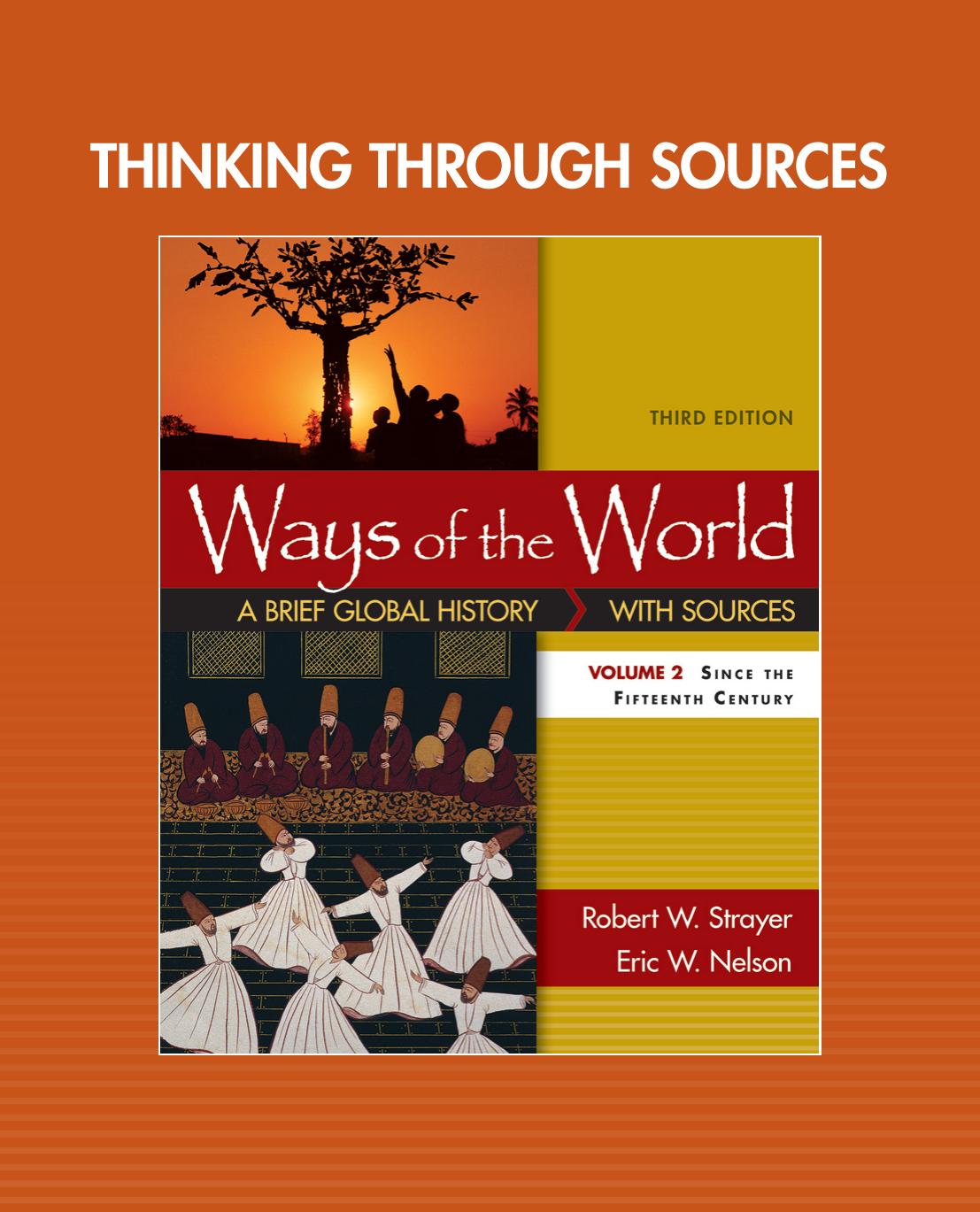
Thinking through Sources for Ways of the World Volume 2 3rd edition by Robert Strayer, Eric Nelson ISBN 1319074650 978-1319074654
Original price was: $70.00.$35.00Current price is: $35.00.
Instant download Thinking through Sources for Ways of the World Volume 2 Robert W. Strayer & Eric W. Nelson after payment
Thinking through Sources for Ways of the World Volume 2 3rd edition by Robert Strayer, Eric Nelson – Ebook PDF Instant Download/Delivery: 1319074650 , 978-1319074654
Full download Thinking through Sources for Ways of the World Volume 2 3rd edition after payment
Product details:
ISBN 10: 1319074650
ISBN 13: 978-1319074654
Author: Robert Strayer, Eric Nelson
Thinking through Sources for Ways of the World, Volume 2 is the second volume of a collection of sources that connects with content in the textbook Ways of the World. With 6-8 sources per chapter, you’ll gain the additional insight into material to have thoughtful classroom discussion and successfully complete assignments.
Thinking through Sources for Ways of the World Volume 2 3rd Table of contents:
Chapter 12: Early Encounters; First Impressions
Source 12.1: Cadamosto in a West African Chiefdom: Alvise da Cadamosto, On Meeting with Budomel
Source 12.2: Vasco da Gama at Calicut, India: A Journal of the First Voyage of Vasco da Gama
Source 12.3: Celebrating da Gama’s Arrival in Calicut: The Arrival of da Gama at Calicut
Source 12.4: Columbus in the Caribbean: Christopher Columbus, Letter to Ferdinand and Isabella
Source 12.5 Columbus Engraved: Columbus Arriving on Hispaniola
Chapter 13: The Spanish and the Aztecs: From Encounter to Conquest
Source 13.1: The Meeting of Cortés and Moctezuma: A Spanish View: Bernal Díaz, The True History of
Source 13.2: The Meeting of Cortés and Moctezuma: An Aztec Account: Fray Bernardino de Sahagún, Th
Source 13.3: Images of Encounter: Moctezuma and Cortés; The Massacre of the Nobles
Source 13.4: Conquest and Victory: The Fall of Tenochtitlán from a Spanish Perspective: Francisco d
Source 13.5: Defeat: The Fall of Tenochtitlán from an Aztec Perspective: Fray Bernardino de Sahagú
Source 13.6: The Battle of Tenochtitlán
Source 13.7: Lamentation: The Aftermath of Defeat: Cantares Mexicanos, Late Sixteenth Century
Chapter 14: Voices from the Slave Trade
Source 14.1: The Journey to Slavery: Olaudah Equiano, The Interesting Narrative of the Life of Olaud
Source 14.2: The Business of the Slave Trade: Thomas Phillips, A Journal of a Voyage Made in the Han
Source 14.3: The Slave Trade and the Kingdom of Kongo: King Affonso I, Letters to King João of Port
Source 14.4: The Slave Trade and the Kingdom of Asante: Osei Bonsu, Conversation with Joseph Dupuis,
Source 14.5: Images of the Slave Trade: Sale of Slaves in West Africa; The Slave Ship Wildfire; Adve
Source 14.6: Data: Patterns of the Slave Trade: Voyages and Slave Rebellion: An Aggregate Statistic;
Chapter 15: Renewal and Reform in the Early Modern World
Source 15.1: Luther’s Protest: Martin Luther, Table Talk, Early Sixteenth Century
Source 15.2: Calvinism and Catholicism: Calvinists Destroying Statues in a Catholic Church
Source 15.3: Progress and Enlightenment: Marquis de Condorcet, Sketch of the Progress of the Human M
Source 15.4: Art and Enlightenment: Joseph Wright, A Philosopher Giving a Lecture on the Orrery
Source 15.5: The Wahhabi Perspective on Islam: Abdullah Wahhab, History and Doctrines of the Wahhabi
Source 15.6: The Poetry of Kabir: Kabir, Poetry, ca. Late Fifteenth Century
Source 15.7: Religious Syncretism in Indian Art: Kumbhaka (breathing exercises)
Chapter 16: Claiming Rights
Source 16.1: The French Revolution and the “Rights of Man”: The Declaration of the Rights of Man
Source 16.2: Representing the Declaration: Declaration of the Rights of Man and Citizen (Painting)
Source 16.3: Rights and National Independence: Simón Bolívar, The Jamaica Letter
Source 16.4: Rights and Slavery: “Reason and Nature”: All Mortals Are Equal, It Is Not Birth but
Source 16.5: Rights and Slavery: An African American Voice: Frederick Douglass, What to the Slave Is
Source 16.6: The Rights of Women: “Frenchwomen Freed”: French Woman during the Revolution
Source 16.7: The Rights of Women: An American Feminist Voice: Elizabeth Cady Stanton, The Solitude o
Chapter 17: Experiencing the Early Industrial Revolution
Source 17.1: The Experience of an English Factory Worker: Elizabeth Bentley, Factory Worker, Testimo
Source 17.2: Urban Living Conditions: Friedrich Engels, The Condition of the Working Class in Englan
Source 17.3: Another View of Factory Life: Outside the Factory
Source 17.4: A Weaver’s Lament: Only a Weaver
Source 17.5: Protest and Song: Eugène Pottier (translated by Charles Kerr), The Internationale
Source 17.6: Railroads and the Middle Class: The Railroad as a Symbol of the Industrial Era
Source 17.7: Inequality: Capital and Labour
Chapter 18: Colonial India: Experience and Response
Source 18.1: Images of Colonial Rule: A British Breakfast in India; Tiger Hunting in Colonial India;
Source 18.2: Seeking Western Education: Ram Mohan Roy, Letter to Lord Amherst
Source 18.3: The Indian Rebellion: Prince Feroze Shah, The Azamgarh Proclamation
Source 18.4: The Credits and Debits of British Rule in India: Dadabhai Naoroji, Speech to a London A
Source 18.5: Gandhi on Modern Civilization: Mahatma Gandhi, Indian Home Rule
Chapter 19: Japan and the West in the Nineteenth Century
Source 19.1: Continuing Japanese Isolation: An Edict of Expulsion
Source 19.2: The Debate: Expel the Barbarians: Tokugawa Nariaki, Memorial on the American Demand for
Source 19.3: The Debate: A Sumo Wrestler and a Foreigner
Source 19.4: The Debate: Eastern Ethics and Western Science: Sakuma Shozan, Reflections on My Errors
Source 19.5: Westernization: Women and Westernization
Source 19.6: A Critique of Westernization: Critique of Wholesale Westernization
Source 19.7: War and Empire
Source 19.8: Japan in the Early Twentieth Century: Okuma Shigenobu, Fifty Years of New Japan
Chapter 20: Experiencing World War I
Source 20.1: Experiences on the Battlefront: Julian Grenfell, Letter from a British Officer in the T
Source 20.2: On the Home Front: Women of Britain Say — “Go!,” 1915; Keep the Home Fires Burnin
Source 20.3: In the Aftermath of the Great War: Otto Dix, Prague Street, 1920; Erich Maria Remarque,
Chapter 21: Experiencing Stalinism
Source 21.1: Stalin on Stalinism: Joseph Stalin, The Results of the First Five-Year Plan
Source 21.2: Collectivization: A Stalinist Vision: The Day of Harvest and Collectivization
Source 21.3: Living through Collectivization: Anna Akimovna Dubova, “Branded Kulaks and Dispossess
Source 21.4: Industrialization and Religion: A Stalinist Vision: Religion Is the Enemy of Industrial
Source 21.5: Living through Stalinist Industrialization: Personal Accounts of Soviet Industrializati
Source 21.6: Living through the Stalinist Terror: Irina Kakhovskaya, Arrest and Interrogation
Chapter 22: Articulating Independence
Source 22.1: Declaring Vietnam’s Independence: Declaration of Independence of the Democratic Repub
Source 22.2: Vietnam’s Independence: Fifty Years Later: Fiftieth Anniversary of Vietnamese Indepen
Source 22.3: India’s “Tryst with Destiny”: Jawaharlal Nehru, Independence Day Speech, August 1
Source 22.4: Another View of India’s Struggle for Independence: Gandhi and the Fight against Briti
Source 22.5: One Africa: Kwame Nkrumah, Africa Must Unite
Source 22.6: South African “Independence”: South African Election
Source 22.7: Independence as Threat: Alvim Pereira, Ten Principles
Chapter 23: The Future as History
Source 23.1: Looking Ahead from 1900: John E. Watkins, “What May Happen in the Next Hundred Years,
Source 23.2: Imagining the Future of Technology: Air Battles and Air Freight in the Future; The Hors
Source 23.3: The United Nations Universal Declaration of Human Rights
Source 23.4: Throwing Off Europe: Frantz Fanon, The Wretched of the Earth
People also search for Thinking through Sources for Ways of the World Volume 2 3rd:
thinking through sources for ways of the world volume 1
thinking through sources for ways of the world pdf
thinking through sources for ways of the world
thinking through sources for ways of the world volume 2
thinking through sources
Tags: Robert Strayer, Eric Nelson, Thinking through, the World