


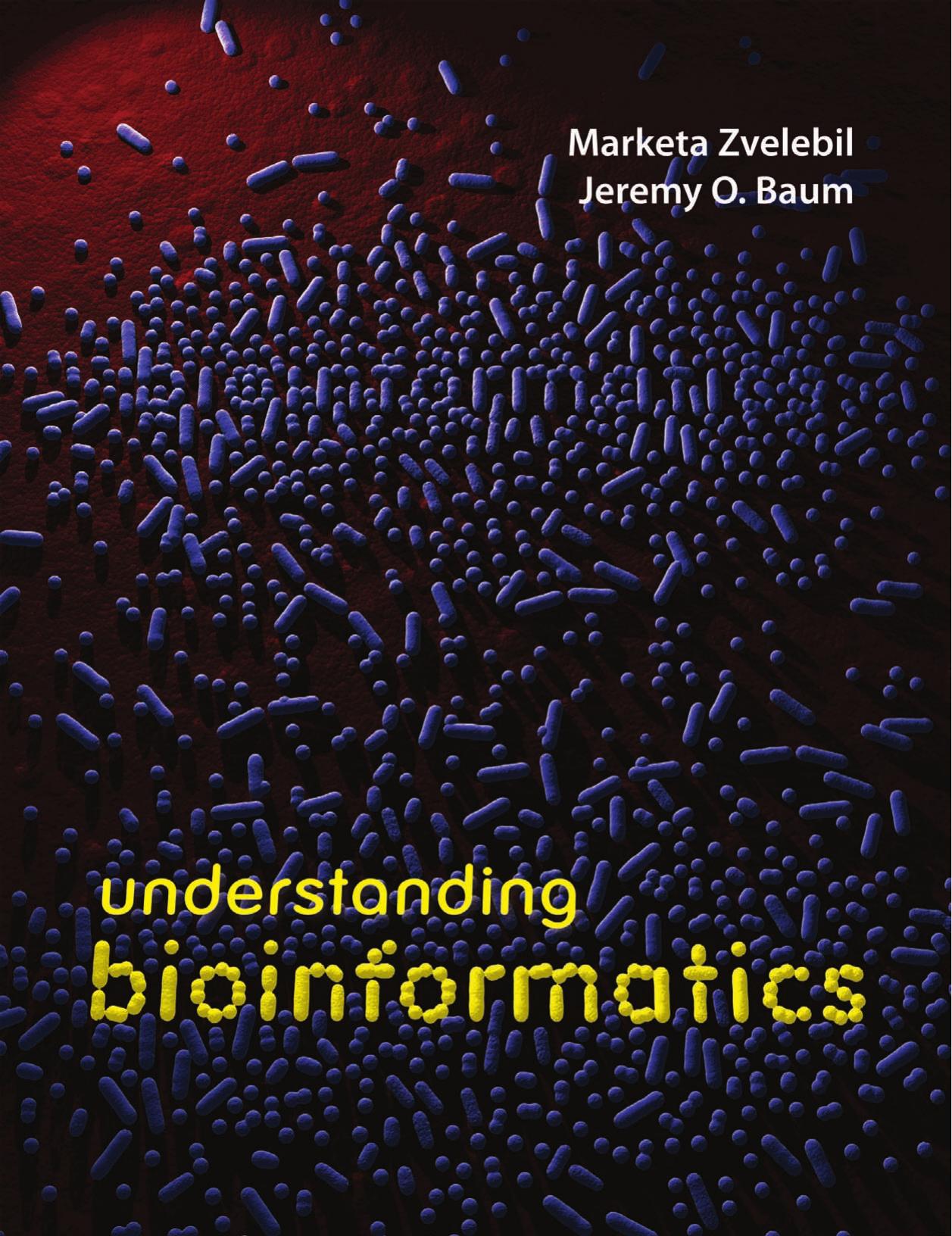
Understanding Bioinformatics 1st edition by Marketa Zvelebil, Jeremy Baum – Ebook PDF Instant Download/Delivery: 0815340249 , 978-08153402
Full download Understanding Bioinformatics 1st edition after payment
Product details:
ISBN 10: 0815340249
ISBN 13: 978-08153402
Author: Marketa Zvelebil, Jeremy Baum
Suitable for advanced undergraduates and postgraduates, Understanding Bioinformatics provides a definitive guide to this vibrant and evolving discipline. The book takes a conceptual approach. It guides the reader from first principles through to an understanding of the computational techniques and the key algorithms. Understanding Bioinformatics is an invaluable companion for students from their first encounter with the subject through to more advanced studies.
The book is divided into seven parts, with the opening part introducing the basics of nucleic acids, proteins and databases. Subsequent parts are divided into ‘Applications’ and ‘Theory’ Chapters, allowing readers to focus their attention effectively. In each section, the Applications Chapter provides a fast and straightforward route to understanding the main concepts and ‘getting started’. Each of these is then followed by Theory Chapters which give greater detail and present the underlying mathematics. In Part 2, Sequence Alignments, the Applications Chapter shows the reader how to get started on producing and analyzing sequence alignments, and using sequences for database searching, while the next two chapters look closely at the more advanced techniques and the mathematical algorithms involved. Part 3 covers evolutionary processes and shows how bioinformatics can be used to help build phylogenetic trees. Part 4 looks at the characteristics of whole genomes. In Parts 5 and 6 the focus turns to secondary and tertiary structure – predicting structural conformation and analysing structure-function relationships. The last part surveys methods of analyzing data from a set of genes or proteins of an organism and is rounded off with an overview of systems biology.
The writing style of Understanding Bioinformatics is notable for its clarity, while the extensive, full-color artwork has been designed to present the key concepts with simplicity and consistency. Each chapter uses mind-maps and flow diagrams to give an overview of the conceptual links within each topic.
Understanding Bioinformatics 1st Table of contents:
Part 1 Background Basics
Chapter 1: The Nucleic Acid World
Chapter 2: Protein Structure
Chapter 3: Dealing With Databases
Part 2 Sequence Alignments
APPLICATIONS CHAPTER: Chapter 4: Producing and Analyzing Sequence Alignments Applications Chapter
THEORY CHAPTER: Chapter 5: Pairwise Seq0uence Alignment and Database Searching Theory Chapter
THEORY CHAPTER: Chapter 6: Patterns, Profiles, and Multiple Alignments Theory Chapter
Part 3 Evolutionary Processes
APPLICATIONS CHAPTER: Chapter 7: Recovering Evolutionary History Applications Chapter
THEORY CHAPTER: Chapter 8: Building Phylogenetic Trees Theory Chapter
Part 4 Genome Characteristics
APPLICATIONS CHAPTER: Chapter 9: Revealing Genome Features Applications Chapter
THEORY CHAPTER: Chapter 10: Gene Detection and Genome Annotation Theory Chapter
Part 5 Secondary Structures
APPLICATIONS CHAPTER: Chapter 11: Obtaining Secondary Structure from Sequence Applications Chapter
THEORY CHAPTER: Chapter 12: Predicting Secondary Structures Theory Chapter
Part 6 Tertiary Structures
APPLICATIONS CHAPTER: Chapter 13: Modeling Protein Structure Applications Chapter
APPLICATIONS CHAPTER: Chapter 14: Analyzing Structure–Function Relationships Applications Chapter
Part 7 Cells and Organisms
Chapter 15: Proteome and Gene Expression Analysis
Chapter 16: Clustering Methods and Statistics
Chapter 17: Systems Biology
People also search for Understanding Bioinformatics 1st :
understanding bioinformatics marketa zvelebil pdf
understanding bioinformatics pdf
understanding bioinformatics
understanding sequencing data as compositions an outlook and review
understanding sequencing data
Tags: Marketa Zvelebil, Jeremy Baum, Understanding Bioinformatics