


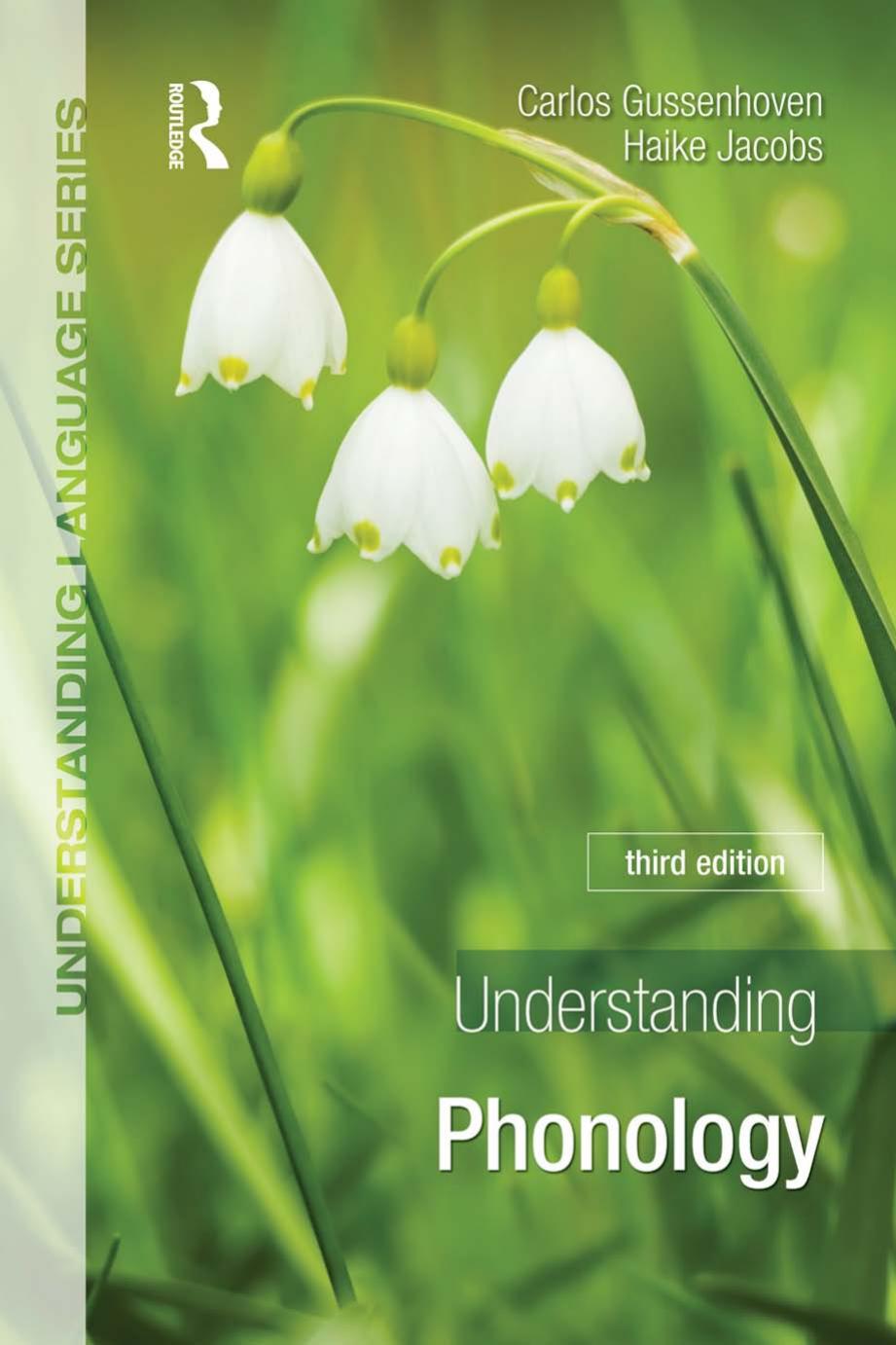
Understanding Phonology 3rd edition by Carlos Gussenhoven, Haike Jacobs – Ebook PDF Instant Download/Delivery: 144411204X , 978-1444112047
Full download Understanding Phonology 3rd edition after payment
Product details:
ISBN 10: 144411204X
ISBN 13: 978-1444112047
Author: Carlos Gussenhoven, Haike Jacobs
This widely acclaimed textbook provides a complete introduction to the phonology of human languages ideal for readers with no prior knowledge of the subject.
This skilfully written text provides a broad, yet up-to-date, introduction to phonology. Assuming no previous knowledge of phonology or linguistic theory, the authors introduce the basic concepts and build on these progressively, discussing the main theories and illustrating key points with carefully chosen examples. A wide range of phenomena are covered: speech production, segmental contrasts, tone, quantity, prosodic structure, metrical relations and intonation. The main theories, including feature geometry and optimality theory are introduced, and their contributions to our understanding of phonology, as well as their shortcomings, are discussed objectively.
This new edition has been updated and revised to meet the needs of today’s students. Difficult points are given fuller explanation, references have been updated, and new exercises have been introduced to enable students to consolidate their learning.
Understanding Phonology 3rd Table of contents:
1. Structures in languages
1.1 Introduction
1.2 Observing Linguistic Structure
1.2.1 What linguists do
1.3 Morphosyntactic Structure
1.3.1 Morphological structure
1.3.2 Syntactic structure
1.4 A World Without Phonological Structure
1.4.1 One phonology for all languages?
1.5 Two Kinds of Structure
1.6 Conclusion
2. The production of speech
2.1 Introduction
2.2 The Lungs and the Larynx
2.2.1 The vocal folds: the open and vibrating glottis
2.2.2 Devoicing and aspiration
2.2.3 Special types of phonation
2.2.4 Pitch
2.2.5 The glottal stop
2.3 The Vocal Tract
2.3.1 The pharynx
2.3.2 The nasal cavity
2.3.3 The mouth
2.4 Vowels
2.5 Constrictions
2.5.1 Places of articulation
Pharyngeal
Dorsal
Coronal
Labial
2.5.2 Types of constriction
Plosives
Fricatives
Affricates
Sonorants
Nasals
Approximants
2.6 Segmental Duration
2.7 Complex Consonants
2.7.1 Secondary articulations
2.7.2 Double articulations
2.7.3 Manner-contour consonants
2.8 Nonpulmonic Consonants
2.9 Stress
2.10 Conclusion
3. Some typology: sameness and difference
3.1 Introduction
3.2 Varying Complexity
3.3 Universals and Implicational Relations
3.3.1 Plain or special?
3.3.2 Avoiding complexity
3.3.3 A word of caution
3.3.4 Speech ergonomics
3.3.5 System gaps
3.6 Conclusion
4. Making the form fit
4.1 Introduction
4.2 Hawaiian
4.3 Adjustment Processes
4.3.1 The process of nativization
4.3.2 Adjustments in the native vocabulary
4.4 Two Approaches
4.4.1 Rules
4.4.2 Constraints
4.5 Choosing Between Rules and Constraints
4.5.1 Gradient violation and unranked constraints
4.6 Conclusion
5. Underlying and surface representations
5.1 Introduction
5.2 Allophonic Variation
5.3 Two Levels of Representation
5.4 Neutralization
5.5 Choosing the Underlying Form
5.6 Conclusion
6. Distinctive features
6.1 Introduction
6.2 Motivating Distinctive Features
6.3 Feature Values
6.4 A Set of Distinctive Features
6.4.1 Major-class features
6.4.2 Laryngeal features
6.4.3 Manner features
6.4.4 Ambiguity and nonspecification
The ambiguous behaviour of [l]
The feature specification of laryngeals
6.5 Place Features
6.5.1 Labial
6.5.2 Coronal
6.5.3 Dorsal
6.5.4 Radical
6.6 Some Examples
6.7 Redundant vs Contrastive Features
6.8 Conclusion
7. SPE. A case study: the diminutive suffix in Dutch
7.1 Introduction
7.2 SPE Representations and Rules
7.2.1 Reference to the syllable
7.2.2 The brace
7.2.3 Variable feature values
7.2.4 Parentheses
7.2.5 The transformational rule format
7.3 Linear Order
7.4 Diminutives in Dutch
7.4.1 Final devoicing
7.4.2 Palatalization
7.4.3 Degemination
7.5 Standard Dutch
7.6 The Dialect of Sittard
7.7 Conclusion
8. Transparency and opacity with rules and constraints
8.1 Introduction
8.2 Extrinsic and Intrinsic Ordering
8.3 Feeding, Counterfeeding, Bleeding, Counterbleeding
8.3.1 Feeding order
8.3.2 Counterfeeding order
8.3.3 Bleeding order
8.3.4 Counterbleeding order
8.4 Transparency and Opacity: Rules and Constraints
8.5 Opacity and OT: Four Solutions
8.5.1 Counterfeeding opacity and Comparative markedness
8.5.2 Counterbleeding opacity and Sympathy Theory
8.5.3 Opacity and Stratal OT
8.5.4 Counterfeeding and counterbleeding opacity in OT with candidate chains
8.6 Conclusion
9. Levels of representation
9.1 Introduction
9.2 Defining an Intermediate Level of Representation
9.3 Lexical Phonology
9.3.1 Reference to morphological labels
9.3.2 Exceptions
9.3.3 Structure preservation
9.3.4 Native-speaker intuitions
9.3.5 Application across word boundaries
9.3.6 Lexical rules apply before postlexical rules
9.4 Phonological Information in the Lexicon
9.5 Controversial Properties of Lexical Rules
9.6 Beyond the Surface Representation
9.6.1 Phonetic implementation
9.6.2 Models of implementation
9.6.3 Deciding between phonology and phonetic implementation
9.7 Conclusion
10. Representing tone
10.1 Introduction
10.2 The Inadequacy of a Linear Model
10.3 Word-Based Tone Patterns
10.3.1 Language-specific associations
10.4 Stability
10.5 Phonetic Implementation of Tone
10.6 Intonation
10.7 The Obligatory Contour Principle
10.7.1 Violating the OCP
10.8 Conclusion
11. Between the segment and the syllable
11.1 Introduction
11.2 A Skeletal Tier
11.3 Syllabification: The Maximum Onset Principle
11.3.1 The sonority profile
11.4 Arguments for the CV Tier
11.4.1 The templatic use of the CV tier
11.4.2 Unfilled and unassociated slots
11.4.3 Compensatory lengthening
11.5 Moras
11.6 Syllable-Based Generalizations
11.7 Post-mop Syllabification Rules
11.7.1 Ambisyllabicity in English
11.8 Conclusion
12. Feature geometry
12.1 Introduction
12.2 Two Properties of Assimilations
12.3 Natural Feature Classes
12.4 Building a Tree
12.4.1 The place node
12.4.2 The laryngeal node
12.4.3 The supralaryngeal node
12.5 Spreading and Delinking
12.5.1 Writing rules
12.6 Implications of Underspecification
12.6.1 Default rules
12.7 Conclusion
13. Exploiting the feature tree
13.1 Introduction
13.2 Long-distance Assimilation
13.2.1 Vowel harmony
13.3 Complex Segments
13.3.1 Evidence for complex segments
13.3.2 The representation of palatals and palatoalveolars
13.3.3 Distinguishing among palatoalveolars
13.4 Conclusion
14. Stress and feet
14.1 Introduction
14.2 The Phonological Nature of Stress
14.2.1 Metrical feet and feet in poetry
14.3 Stress as an Absolute Property of Segments: Linear Phonology
14.4 Stress as Relative Prominence: Nonlinear Phonology
14.4.1 A parametric theory of relative prominence
14.4.2 Four types of bounded stress system
14.5 Conclusion
15. Further constraining stress
15.1 Introduction
15.2 Iambic and Trochaic Rhythm
15.3 Foot-Based Rules
15.3.1 Quantitative adjustments
15.3.2 Foot-based segmental rules
15.4 Stress and Morphology
15.5 Stress and Optimality Theory
15.6 Constraining Stress
15.7 Conclusion
16. Phonology above the word
16.1 Introduction
16.2 Generalizations Involving Prosodic Constituents
16.3 The Strict Layer Hypothesis
16.4 Factors Determining Prosodic Phrasing
16.5 The Prosodic Constituents
16.5.1 The utterance
16.5.2 The intonational phrase
16.5.3 The phonological phrase
16.5.4 The phonological word
16.6 Deriving Prosodic Constituents
16.6.1 Clitics
16.6.2 The syntactic residue
16.7 Prosodic Constituency Below the Phonological Word
16.8 Conclusion
People also search for Understanding Phonology 3rd :
understanding phonology carlos gussenhoven and haike jacobs
understanding phonology pdf
understanding phonology
understanding phonology gussenhoven
gussenhoven carlos
Tags: Carlos Gussenhoven, Haike Jacobs, Understanding Phonology