


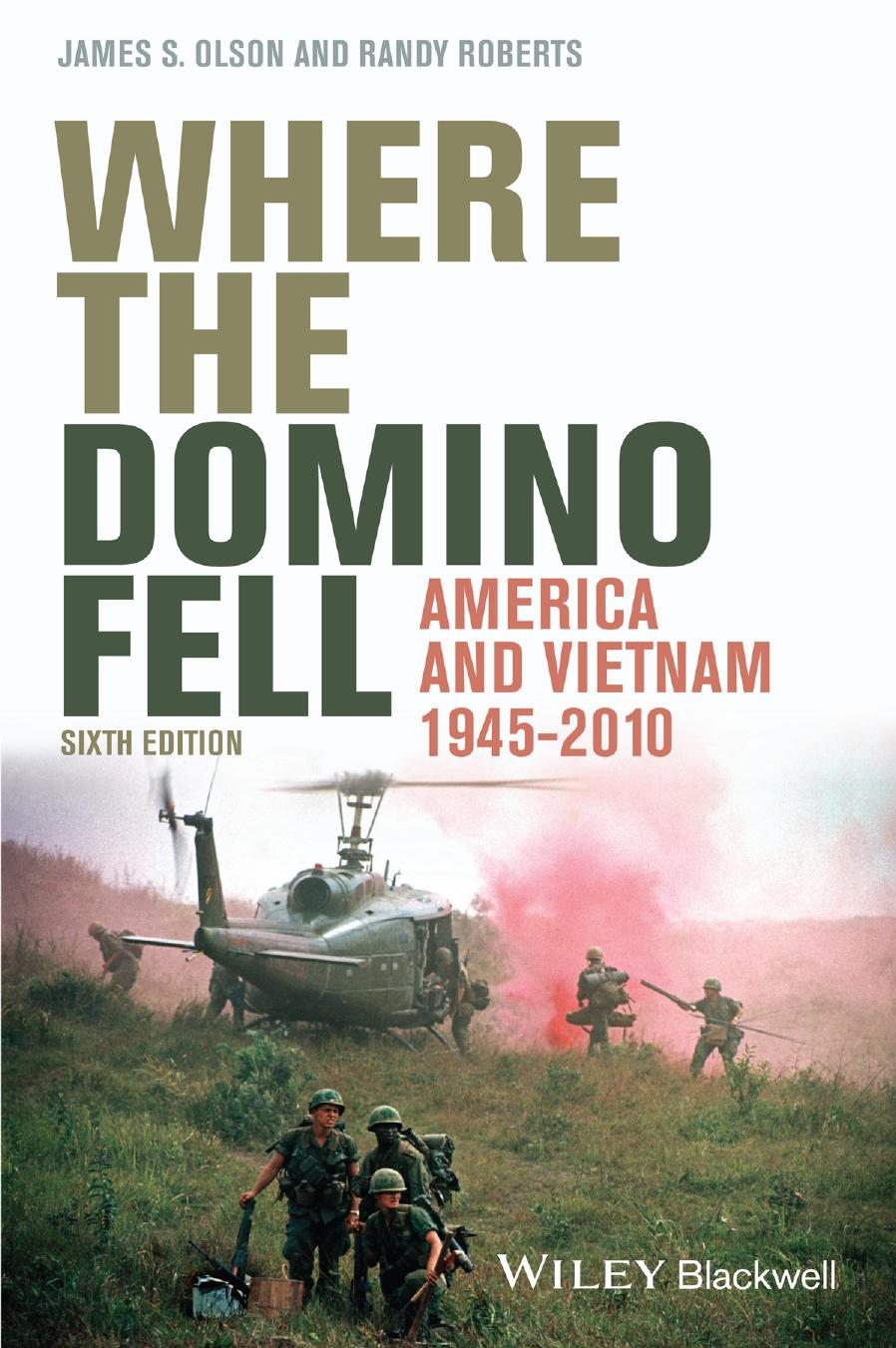
Where the Domino Fell America and Vietnam 1945 2010 6th Edition by James Olson, Randy Roberts ISBN 1444350501 978-1444350500
Original price was: $70.00.$35.00Current price is: $35.00.
Instant download Where the Domino Fell America and Vietnam 1945 2010 Sixth Edition James S. Olson & Randy Roberts after payment
Where the Domino Fell America and Vietnam 1945 2010 6th Edition by James Olson, Randy Roberts – Ebook PDF Instant Download/Delivery: 1444350501, 978-1444350500
Full download Where the Domino Fell America and Vietnam 1945 2010 6th edition after payment
Product details:
ISBN 10: 1444350501
ISBN 13: 978-1444350500
Author: James Olson, Randy Roberts
This updated, expanded edition of Where the Domino Fell recounts the history of American involvement in Vietnam from the end of World War II, clarifying the political aims, military strategy, and social and economic factors that contributed to the participants’ actions.
- Revised and updated to include an examination of Vietnam through the point of view of the soldiers themselves, and brings the story up to the present day through a look at how the war has been memorialized
- A final chapter examines Vietnam through the lens of Oliver Stone’s films and opens up a discussion of the War in popular culture
- Written with brevity and clarity, this concise narrative history of the Vietnam conflict is an ideal student text
- A chronology, glossary, and a bibliography all serve as helpful reference points for students
- An important contribution not only to the study of the Vietnam War but to an understanding of the larger workings of American foreign policy
Where the Domino Fell America and Vietnam 1945 2010 6th Table of contents:
1 Eternal War The Vietnamese Heritage
The Trung Sisters
Figure 1.1 September 1945—Ho Chi Minh, right, poses with Vo Nguyen Giap, minister of the Interior in Ho Chi Minh’s provisional government. Giap led the Vietminh and North Vietnamese military through the fall of Saigon. (Courtesy, AP/Wide World Photos.)
2 The First Indochina War, 1945–1954
Figure 2.1 January 12, 1947—Some of the 8,000 French troops aboard the Ile de France prior to departure from Toulon Harbor for duty in Indochina. (Courtesy, AP/Wide World Photos.)
Figure 2.2 February 1954—General Henri Navarre (left), commander of French forces in Indochina, reviews the troops at an inspection of the camp Dienbienphu with Colonel Christian de Castries (center), commander of the camp and General René Cogny (right), commander of forces in North Vietnam. (Courtesy, AP/Wide World Photos.)
3 The Making of a Quagmire, 1954–1960
Figure 3.1 December 8, 1950—Ex-emperor Bao Dai and General Marcel Carpentier, commander in chief of French forces in the Far East, enjoy refreshment in the presidential palace in Saigon after signing the French-Vietnam military pact creating a pro-French Vietnam army. (Courtesy, Library of Congress.)
Figure 3.2 1961—Ngo Dinh Diem, president of South Vietnam, rides through the streets of Saigon. (Courtesy, National Archives.)
Figure 3.3 May 9, 1963—Ngo Dinh Nhu, brother and adviser to South Vietnamese President Ngo Dinh Diem, sits in front of a map of Southeast Asia in his study in the presidential palace in Saigon. (Courtesy, AP/Wide World Photo.)
Figure 3.4 Madame Ngo Dinh Nhu, wife of Ngo Dinh Nhu, brother and close adviser to President Diem. She was officially the first lady of Vietnam and an active leader in anti-Buddhist government actions. (Courtesy, AP/Wide World Photo.)
Map 2 Vietnam, showing the 1954 North/South division, and routes of invasions and evacuations, 1945 to 1975.
4 The New Frontier in Vietnam, 1961–1963
Figure 4.1 Walt W. Rostow, a member of the Kennedy and Johnson administrations, was one of the “best and brightest” who led the United States into the Vietnam War. (Courtesy, Library of Congress.)
Figure 4.2 Quang Duc, an elderly Buddhist priest, immolates himself in protest against the Diem regime’s religious persecution. (Courtesy, National Archives.)
5 Planning a Tragedy, 1963–1965
General Harold G. “Hal” Moore, Jr.
Figure 5.1 August 1964—The American destroyer USS Maddox was attacked by torpedoes and gunfire off Vietnam in the Gulf of Tonkin. (Courtesy, Library of Congress.)
Figure 5.2 Kim Phuc, who ripped off her burning clothes during a napalm raid, runs down the highway. At left is her younger brother who lost an eye in the attack and, at right, other members of her family. (Courtesy, Library of Congress.)
6 Into the Abyss, 1965–1966
Figure 6.1 From left, U.S. Secretary of State Dean Rusk, South Vietnamese Prime Minister Nguyen Cao Ky, and U.S. Ambassador to Vietnam Henry Cabot Lodge meet in Saigon. (Courtesy, National Archives.)
Figure 6.2 July 14, 1965—U.S. Army nurses Capt. Gladys E. Sepulveda, left, of Ponce, Puerto Rico, and 2nd Lt. Lois Ferrari, of Pittsburgh, Pennsylvania, rest on sandbags at Cam Ranh Bay in South Vietnam. (Courtesy, Library of Congress.)
7 The Mirage of Progress, 1966–1967
Figure 7.1 A truck convoy rolls along a road into Laos and the Ho Chi Minh Trail as it transports supplies to North Vietnamese troops fighting in South Vietnam. (Courtesy, National Archives.)
Figure 7.2 U.S. Air Force F-105 Thunderchief fighter-bombers drop bombs on North Vietnam. (Courtesy, Library of Congress.)
Figure 7.3 “Waist Deep in the Big Muddy” folk artist Pete Seeger sang of such scenes as this one. (Courtesy, Library of Congress.)
Figure 7.4 Dr. Benjamin Spock, Dr. Martin Luther King Jr., and Monsignor Charles O. Rice link arms as they march in an anti-Vietnam War rally in New York’s Central Park, April 1967. (Courtesy, Library of Congress.)
8 Tet and the Year of the Monkey, 1968
Hugh Thompson, Jr.
Figure 8.1 February 2, 1968—ARVN Colonel Nguyen Ngoc Loan pulls out his pistol and executes a Vietcong on the spot with a single shot to the head. (Courtesy, Library of Congress.)
Map 3 Major battles of the Tet offensive, January 1968.
Figure 8.2 August 28, 1968—Police squirt mace into a tightly packed crowd at an antiwar demonstration outside the Conrad Hilton hotel in Chicago. Hundreds were injured in the bloody clash. (Courtesy, Library of Congress.)
9 The Beginning of the End, 1969–1970
Stephen Thomas
Figure 9.1 March 1968—Bodies of women and children lie on the road leading from the village of My Lai following the massacre of South Vietnamese civilians by American troops. (Courtesy, Library of Congress.)
10 The Fall of South Vietnam, 1970–1975
Figure 10.1 North Vietnam’s Lo Duc Tho and U.S. negotiator Henry Kissinger meet in secret at Saint-Nom-La-Broteche near Paris to seek agreement on a ceasefire in Vietnam. (Courtesy, Library of Congress.)
Figure 10.2 April 1, 1975—A U.S. civilian pilot in the aircraft doorway tries to maintain order as panicking South Vietmamese civilians scramble to get aboard. Thousands of civilians and South Vietnamese soldiers fought for space. (Courtesy, Library of Congress.)
Figure 10.3 Although the design of the Vietnam Veterans Memorial triggered a storm of protest in the United States, the “wall” eventually became a sacred shrine to millions of people who visited it. (© ES James/Shutterstock.com)
11 Distorted Images, Missed Opportunities, 1975–1995
Figure 11.1 The Vietnam Women’s Memorial, dedicated in 1993, commemorates the service and sacrifice of tens of thousands of American women who spent part of their lives in Vietnam. (© Steve Heap/Shutterstock.com)
12 Oliver Stone’s Vietnam
People also search for Where the Domino Fell America and Vietnam 1945 2010 6th:
where the domino fell summary
where the domino fell audiobook
where the domino fell pdf
where the domino fell
where the domino fell chapter summaries
Tags: James Olson, Randy Roberts, Fell America