

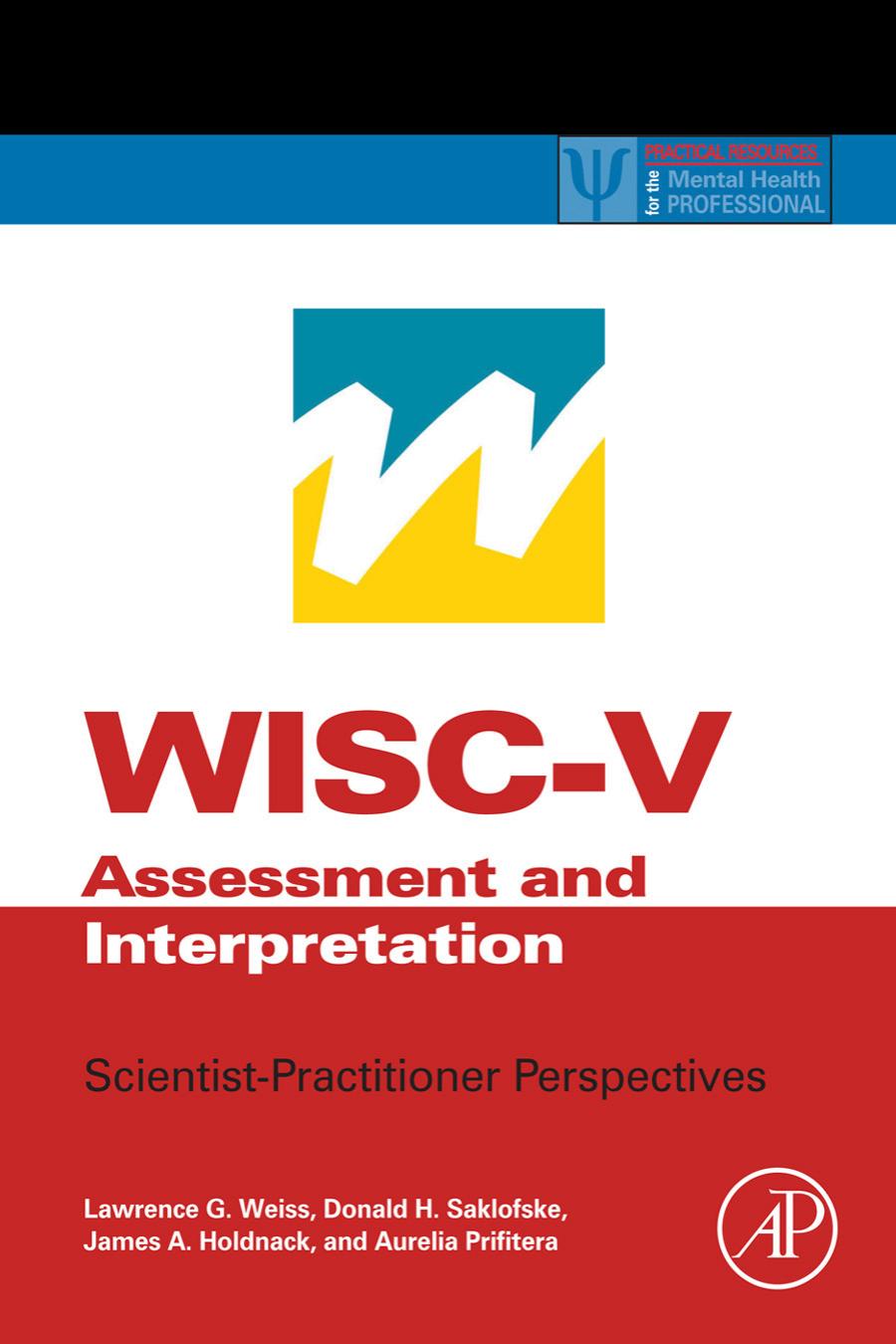
WISC V Assessment and Interpretation 1st edition by Lawrence Weiss, Donald Saklofske, James Holdnack, Aurelio Prifitera ISBN 0124046975 978-0124046979
Original price was: $70.00.$35.00Current price is: $35.00.
Instant download WISC V Assessment and Interpretation Scientist Practitioner Perspectives Lawrence G. Weiss & Donald H. Saklofske & James A. Holdnack & Aurelio Prifitera after payment
WISC V Assessment and Interpretation 1st edition by Lawrence Weiss, Donald Saklofske, James Holdnack, Aurelio Prifitera – Ebook PDF Instant Download/Delivery: 0124046975 , 978-0124046979
Full download WISC V Assessment and Interpretation 1st edition after payment
Product details:
ISBN 10: 0124046975
ISBN 13: 978-0124046979
Author: Lawrence Weiss, Donald Saklofske, James Holdnack, Aurelio Prifitera
The Wechsler Intelligence Scale is the most widely used intelligence test for children worldwide. WISC V introduces new subtests, composite scores, process scores, error scores, and scaled scores as a more complex and accurate means of assessing cognitive abilities. WISC V Assessment and Interpretation provides practical information for clinicians on selection of subtest measures, administration, and interpretation.
New subtests are described along with tips for accurate administration and scoring. Full Scale IQ is identified as important for predicting relevant behaviors, and primary index scores for characterizing the child’s strengths and weaknesses. Classroom indicators of low scores on each of these abilities are identified, with suggested interventions, accommodations, and instructional strategies for low scorers. Coverage includes ethnic differences for the Full Scale IQ and each primary index score, along with evidence of the profound influence of parental attitudes and expectations. Several other societal and contextual factors relevant to understanding racial/ethnic differences are presented. Two chapters review use of the WISC V for identifying learning disabilities, testing of individuals with dyslexia, and best practice recommendations to ensure accurate diagnosis and intervention. Concluding chapters describe advances in the Q interactive system platform allowing administration of the WISC V on iPads and other tablets and how clinicians can tailor assessment using select WISC V subtests and features.
WISC V Assessment and Interpretation 1st Table of contents:
Part I: Applied Considerations
Chapter 1. WISC-V: Advances in the Assessment of Intelligence
Introduction
A Brief Historical Recap
From the Past to the Present
Structure and Content of the WISC-V
The WISC-V Primary Indexes and Subtests
The WISC-V Full Scale Intelligence Quotient
The WISC-V Ancillary Indexes and Subtests
The WISC-V Complementary Indexes and Subtests
Summary
References
Chapter 2. Practical Issues in WISC-V Administration and Scoring
Introduction
General WISC-V Administration and Scoring Tips
Administering the WISC-V Subtests
Concluding Comments
Appendix 2A Frequently Asked Questions
Appendix 2B How is WISC-V Different from WISC-IV?
References
Chapter 3. Practical Considerations in WISC-V Interpretation and Intervention
Introduction
Levels Of Interpretation: When The Overall Ability Score Does Not Tell The Whole Story
Personifying the Primary Abilities: A Simple Analogy
Issues Related to Intervention
Intervention Suggestions Related to Verbal Comprehension
Intervention Suggestions Related To Visual–Spatial Processing
Intervention Suggestions Related to Fluid Reasoning
Intervention Suggestions Related to Working Memory
Intervention Suggestions Related to Processing Speed
Case Example
References
Part II: Theoretical Considerations
Chapter 4. Theoretical and Clinical Foundations of the WISC-V Index Scores
Introduction
The WISC-V Index Scores
The Role of Executive Functions in Intelligence
An Integrative Theory of Cognitive Abilities
Summary
References
Chapter 5. WISC-V Use in Societal Context
Bias Issues in Intellectual Assessment
Consequences of Testing and the Fairness of Test Use in Special Education
Demographic Disparities in Various Areas of Life
Cognitive Development, Home Environment, and Culture
The Role of Cognitive Stimulation in Intellectual Development
The Role of the Child in Academic and Intellectual Development
Patterns Of WISC-V IQ Scores Across Culturally and Linguistically Diverse Groups
SES Mediators of FSIQ Differences Between Culturally and Linguistically Diverse Groups
Further Considerations of Home Environment on Intellectual and Academic Development of Children
Conclusions Regarding Home Environment and Cognitive Development
Summary
References
Chapter 6. The Flynn Effect and Its Clinical Implications
What do we Know about the Flynn Effect?
Implications of the Flynn Effect for Practitioners
The Flynn Effect in the WISC-V
Recommendations
References
Part III: Clinical Considerations
Chapter 7. Testing Hispanics with WISC-V and WISC-IV Spanish
Introduction
Testing Hispanics with WISC-V
Hispanic Base Rates for WISC-V
Testing Spanish-Speaking Clients
Use of Interpreters
Summary and Conclusions
Acknowledgments
References
Chapter 8. WISC-V and the Evolving Role of Intelligence Testing in the Assessment of Learning Disabilities
Introduction
Learning Disability: Current Definitions and Subtypes
Intelligence: A Key Link in the Assessment and Diagnosis of Learning Disability
A Taxonomy of Cognitive Abilities Related to Learning Disabilities
Revisiting SLD Identification with the WISC-V
Summary and Concluding Comments
References
Chapter 9. Translating Scientific Progress in Dyslexia into Twenty-first Century Diagnosis and Interventions
Introduction
Evolution of Dyslexia as an Unexpected Difficulty in Relation to Intelligence
Neurobiological Evidence Supporting Dyslexia
Necessity and Challenge of Bringing Diagnosis of Dyslexia into the Twenty-First Century
Diagnosis of Dyslexia in Adolescents and Young Adults
Summary
Acknowledgments
References
Chapter 10. Issues Related to the WISC-V Assessment of Cognitive Functioning in Clinical and Special Groups
Introduction
The Relevance and Purpose of Cognitive Assessment
Clinical and Special Groups: General Description and Intellectual Functioning
Intellectual Assessment with the WISC-V in Diagnostic and Treatment Planning
WISC-V Performance in Special Groups
Summary
References
Part IV: Current and Future Directions
Chapter 11. Digital Assessment with Q-interactive
Introduction
Overview of Components and Workflow
Assess
Central
Implications for Professional Practice
Future Directions
References
Chapter 12. WISC-V and the Personalized Assessment Approach
Introduction
Obtaining and Refining Initial Impressions of the Child
People also search for WISC V Assessment and Interpretation 1st :
wisc v assessment and interpretation scientist practitioner perspectives
wisc v assessment and interpretation scientist practitioner perspectives pdf
how to interpret wisc v scores
wisc-v assessment and interpretation pdf
wisc-v assessment and interpretation
Tags: Lawrence Weiss, Donald Saklofske, James Holdnack, Aurelio Prifitera, WISC V