


A Writer’s Reference with Exercises 9th Edition by Diana Hacker, Nancy Sommers – Ebook PDF Instant Download/Delivery: 131910696X , 978-1319106966
Full download A Writer’s Reference with Exercises 9th edition after payment
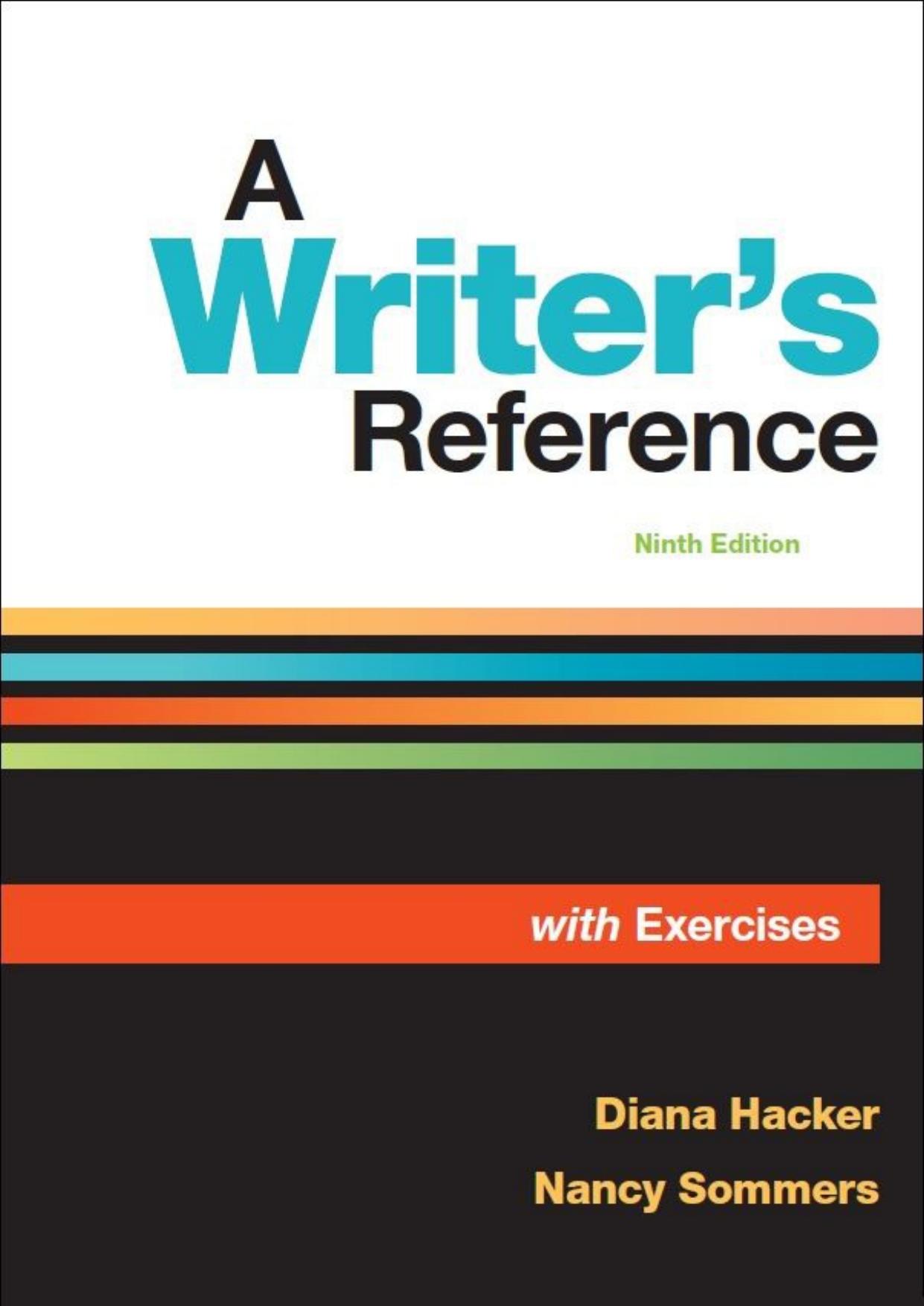
Product details:
ISBN 10: 131910696X
ISBN 13: 978-1319106966
Author: Diana Hacker, Nancy Sommers
Emphasizing critical reading and writing, Writer’s Reference with Exercises build your confidence as a college writing through help that’s personal, practical, and digital.
A Writer’s Reference with Exercises 9th Table of contents:
- C: Composing and Revising
- C1 Planning
- C1-a Assess the writing situation
- C1-b Explore your subject
- C1-c Draft and revise a working thesis statement
- How to solve five common problems with thesis statements
- C1-d Draft a plan
- C2 Drafting
- C2-a Draft an introduction
- C2-b Draft the body
- C2-c Draft a conclusion
- C3 Reviewing, revising, and editing
- C3-a See revising as a social process
- C3-b Use peer review: Revise with comments
- C3-c Use peer review: Give constructive comments
- How to write helpful peer review comments
- Strategies for revising with comments
- C3-d Highlights of one student’s peer review process
- C3-e Approach global revision in cycles
- C3-f Revise and edit sentences
- How to improve your writing with an editing log
- C3-g Proofread the final manuscript
- C3-h Sample student revision: Literacy narrative
- Writing guide: How to write a literacy narrative
- C3-i Format the final manuscript
- C4 Preparing a portfolio; reflecting on your writing
- C4-a Understand the benefits of reflection
- C4-b Student writing: Reflective letter for a portfolio
- Writing guide: How to write a reflective letter
- C5 Writing paragraphs
- C5-a Focus on a main point
- C5-b Develop the main point
- C5-c Choose a suitable pattern of organization
- C5-d Make paragraphs coherent
- C5-e If necessary, adjust paragraph length
- A: Academic Reading, Writing, and Speaking
- A1 Reading and writing critically
- A1-a Read actively
- How to read like a writer
- A1-b Outline a text to identify main ideas
- A1-c Summarize to deepen your understanding
- A1-d Analyze to demonstrate your critical thinking
- How to draft an analytical thesis statement
- A1-e Sample student essay: Analysis of an article
- Writing guide: How to write an analytical essay
- A2 Reading and writing about multimodal texts
- A2-a Read actively
- A2-b Outline to identify main ideas
- A2-c Summarize to deepen your understanding
- How to write a summary of a multimodal text
- A2-d Analyze to demonstrate your critical reading
- A2-e Sample student writing: Analysis of an advertisement
- A3 Reading arguments
- A3-a Distinguish between reasonable and fallacious argumentative tactics
- A3-b Distinguish between legitimate and unfair emotional appeals
- A3-c Judge how fairly a writer handles opposing views
- A4 Writing arguments
- A4-a Identify your purpose and context
- A4-b View your audience as a panel of jurors
- A4-c In your introduction, establish credibility and state your position
- How to draft a thesis statement for an argument
- A4-d Back up your thesis with persuasive lines of argument
- A4-e Support your claims with specific evidence
- A4-f Anticipate objections; counter opposing arguments
- A4-g Build common ground
- A4-h Sample student writing: Argument
- Writing guide: How to write an argument essay
- A5 Speaking confidently
- A5-a Identify your purpose, audience, and context
- A5-b Prepare a presentation
- How to deliver a speech or presentation
- A5-c Remix an essay for a presentation
- A6 Writing in the disciplines
- A6-a Find commonalities across disciplines
- A6-b Recognize the questions writers in a discipline ask
- A6-c Understand the kinds of evidence writers in a discipline use
- A6-d Become familiar with a discipline’s language conventions
- A6-e Use a discipline’s preferred citation style
- S: Sentence Style
- S1 Parallelism
- S1-a Balance parallel ideas in a series
- S1-b Balance parallel ideas presented as pairs
- S1-c Repeat function words to clarify parallels
- S2 Needed words
- S2-a Add words needed to complete compound structures
- S2-b Add the word that if there is any danger of misreading without it
- S2-c Add words needed to make comparisons logical and complete
- S2-d Add the articles a, an, and the where necessary for grammatical completeness
- S3 Problems with modifiers
- S3-a Put limiting modifiers in front of the words they modify
- S3-b Place phrases and clauses so that readers can see at a glance what they modify
- S3-c Move awkwardly placed modifiers
- S3-d Avoid split infinitives when they are awkward
- S3-e Repair dangling modifiers
- S4 Shifts
- S4-a Make the point of view consistent in person and number
- S4-b Maintain consistent verb tenses
- S4-c Make verbs consistent in mood and voice
- Writer’s choice: Choosing a point of view
- S4-d Avoid sudden shifts from indirect to direct questions or quotations
- S5 Mixed constructions
- S5-a Untangle the grammatical structure
- S5-b Straighten out the logical connections
- S5-c Avoid is when, is where, and reason . . . is because constructions
- S6 Sentence emphasis
- S6-a Coordinate equal ideas; subordinate minor ideas
- S6-b Combine choppy sentences
- Writer’s choice: Positioning major and minor ideas
- S6-c Avoid ineffective or excessive coordination
- S6-d Do not subordinate major ideas
- S6-e Do not subordinate excessively
- S6-f Experiment with techniques for gaining emphasis
- S7 Sentence variety
- S7-a Vary your sentence openings
- Writer’s choice: Stengthening with variety
- S7-b Use a variety of sentence structures
- S7-c Try inverting sentences occasionally
- S7-d Consider adding an occasional question
- W: Word Choice
- W1 Glossary of usage
- W2 Wordy sentences
- W2-a Eliminate redundancies
- W2-b Avoid unnecessary repetition of words
- W2-c Cut empty or inflated phrases
- W2-d Simplify the structure
- W2-e Reduce clauses to phrases, phrases to single words
- W3 Active verbs
- W3-a Choose the active voice or the passive voice depending on your writing situation
- W3-b Replace be verbs that result in dull or wordy sentences
- Writer’s choice: Using the active or the passive voice
- W3-c As a rule, choose a subject that names the person or thing doing the action
- W4 Appropriate language
- W4-a Avoid jargon, except in specialized writing situations
- W4-b Avoid pretentious language, most euphemisms, and “doublespeak.”
- Writer’s choice: Using discipline-specific terms
- W4-c Avoid obsolete and invented words
- W4-d In most contexts, avoid slang, regional expressions, and nonstandard English
- W4-e Choose an appropriate level of formality
- W4-f Avoid sexist language
- W4-g Revise language that may offend groups of people
- W5 Exact language
- W5-a Select words with appropriate connotations
- W5-b Prefer specific, concrete nouns
- W5-c Do not misuse words
- W5-d Use standard idioms
- W5-e Do not rely heavily on clichés
- W5-f Use figures of speech with care
- G: Grammatical Sentences
- G1 Subject-verb agreement
- G1-a Learn to recognize standard subject-verb combinations
- G1-b Make the verb agree with its subject, not with a word that comes between
- G1-c Treat most subjects joined with and as plural
- G1-d With subjects joined with or or nor (or with either . . . or or neither . . . nor), make the verb agree with the part of the subject nearer to the verb
- G1-e Treat most indefinite pronouns as singular
- G1-f Treat collective nouns as singular unless the meaning is clearly plural
- G1-g Make the verb agree with its subject even when the subject follows the verb
- G1-h Make the verb agree with its subject, not with a subject complement
- G1-i Who, which, and that take verbs that agree with their antecedents
- G1-j Words such as athletics, economics, mathematics, physics, politics, statistics, measles, and news are usually singular, despite their plural form
- G1-k Titles of works, company names, words mentioned as words, and gerund phrases are singular
- G2 Verb forms, tenses, and moods
- G2-a Choose Standard English forms of irregular verbs
- G2-b Distinguish among the forms of lie and lay
- G2-c Use -s (or -es) endings on present-tense verbs that have third-person singular subjects
- G2-d Do not omit -ed endings on verbs
- G2-e Do not omit needed verbs
- G2-f Choose the appropriate verb tense
- G2-g Use the subjunctive mood in the few contexts that require it
- G3 Pronouns
- G3-a Make pronouns and antecedents agree
- G3-b Make pronoun references clear
- G3-c Distinguish between pronouns such as I and me
- G3-d Distinguish between who and whom
- G4 Adjectives and adverbs
- G4-a Use adjectives to modify nouns
- G4-b Use adverbs to modify verbs, adjectives, and other adverbs
- G4-c Distinguish between good and well, bad and badly
- G4-d Use comparatives and superlatives with care
- G4-e Avoid double negatives
- G5 Sentence fragments
- G5-a Attach fragmented subordinate clauses or turn them into sentences
- G5-b Attach fragmented phrases or turn them into sentences
- G5-c Attach other fragmented word groups or turn them into sentences
- G5-d Exception: A fragment may be used for effect
- G6 Run-on sentences
- Writer’s choice: Clustering ideas in meaningful ways
- G6-a Consider separating the clauses with a comma and a coordinating conjunction
- G6-b Consider separating the clauses with a semicolon, a colon, or a dash
- G6-c Consider making the clauses into separate sentences
- G6-d Consider restructuring the sentence, perhaps by subordinating one of the clauses
- M: Multilingual Writers and ESL Topics
- M1 Verbs
- M1-a Use the appropriate verb form and tense
- M1-b To write a verb in the passive voice, use a form of be with the past participle
- M1-c Use the base form of the verb after a modal
- M1-d To make negative verb forms, add not in the appropriate place
- M1-e In a conditional sentence, choose verb tenses according to the type of condition expressed in the sentence
- M1-f Become familiar with verbs that may be followed by gerunds or infinitives
- M2 Articles
- M2-a Be familiar with articles and other noun markers
- M2-b Use the with most specific common nouns
- M2-c Use a (or an) with common singular count nouns that refer to “one” or “any.”
- M2-d Use a quantifier such as some or more, not a or an, with a noncount noun to express an approximate amount
- M2-e Do not use articles with nouns that refer to all of something or to something in general
- M2-f Do not use articles with most singular proper nouns. Use the with most plural proper nouns
- M3 Sentence structure
- M3-a Use a linking verb between a subject and its complement
- M3-b Include a subject in every sentence
- M3-c Do not use both a noun and a pronoun to perform the same grammatical function in a sentence
- M3-d Do not repeat a subject, an object, or an adverb in an adjective clause
- M3-e Avoid mixed constructions beginning with although or because
- M3-f Do not place an adverb between a verb and its direct object
- M4 Using adjectives
- M4-a Distinguish between present participles and past participles used as adjectives
- M4-b Place cumulative adjectives in an appropriate order
- M5 Prepositions and idiomatic expressions
- M5-a Become familiar with prepositions that show time and place
- M5-b Use nouns (including -ing forms) after prepositions
- M5-c Become familiar with common adjective + preposition combinations
- M5-d Become familiar with common verb + preposition combinations
- M6 Paraphrasing sources effectively
- M6-a Avoid replacing a source’s words with synonyms
- M6-b Determine the meaning of the original source
- M6-c Present the author’s meaning in your own words
- P: Punctuation and Mechanics
- P1 The comma
- P1-a Use a comma before a coordinating conjunction joining independent clauses
- P1-b Use a comma after an introductory clause or phrase
- P1-c Use a comma between all items in a series
- P1-d Use a comma between coordinate adjectives not joined with and. Do not use a comma between cumulative adjectives
- P1-e Use commas to set off nonrestrictive (nonessential) elements. Do not use commas to set off restrictive (essential) elements
- P1-f Use commas to set off transitional and parenthetical expressions, absolute phrases, and word groups expressing contrast
- P1-g Use commas to set off nouns of direct address, the words yes and no, interrogative tags, and mild interjections
- P1-h Use commas with expressions such as he said to set off direct quotations
- P1-i Use commas with dates, addresses, titles, and numbers
- P2 Unnecessary commas
- P2-a Do not use a comma with a coordinating conjunction that joins only two words, phrases, or subordinate clauses
- P2-b Do not use a comma to separate a verb from its subject or object
- P2-c Do not use a comma before the first or after the last item in a series
- P2-d Do not use a comma between cumulative adjectives, between an adjective and a noun, or between an adverb and an adjective
- P2-e Do not use commas to set off restrictive elements
- P2-f Do not use a comma to set off a concluding adverb clause that is essential for meaning
- P2-g Do not use a comma after a phrase that begins an inverted sentence
- P2-h Avoid other common misuses of the comma
- P3 The semicolon and the colon
- P3-a Use a semicolon between closely related independent clauses
- P3-b Use a semicolon between items in a series containing internal punctuation
- P3-c Avoid common misuses of the semicolon
- P3-d Use a colon after an independent clause to direct attention to a list, an appositive, a quotation, or a summary or an explanation
- P3-e Use a colon according to convention
- P3-f Avoid common misuses of the colon
- P4 The apostrophe
- P4-a Use an apostrophe to indicate that a noun is possessive
- P4-b Use an apostrophe to mark omissions in contractions and numbers
- P4-c Do not use an apostrophe in certain situations
- P4-d Avoid common misuses of the apostrophe
- P5 Quotation marks
- P5-a Use quotation marks to enclose direct quotations
- P5-b Use single quotation marks to enclose a quotation within a quotation
- P5-c Use quotation marks around the titles of short works
- P5-d Quotation marks may be used to set off words used as words
- P5-e Use punctuation with quotation marks according to convention
- P5-f Avoid common misuses of quotation marks
- P6 Other punctuation marks
- P6-a End punctuation
- P6-b The dash, parentheses, and brackets
- P6-c The ellipsis mark
- P6-d The slash
- P7 Spelling and hyphenation
- P7-a Become familiar with the major spelling rules
- P7-b Be alert to commonly misspelled words
- P7-c Be alert to commonly misspelled words
- P7-d Hyphenate two or more words used together as an adjective before a noun
- P7-e Hyphenate two or more words used together as an adjective before a noun
- P7-f Hyphenate fractions and certain numbers when they are spelled out
- P7-g Use a hyphen with the prefixes all-, ex- (meaning “former”), and self- and with the suffix -elect
- P7-h Use a hyphen in certain words to avoid ambiguity
- P7-i Check for correct word breaks when words must be divided at the end of a line
- P8 Capitalization
- P8-a Capitalize proper nouns and words derived from them; do not capitalize common nouns
- P8-b Capitalize titles of persons when used as part of a proper name but usually not when used alone
- P8-c Capitalize titles according to convention
- P8-d Capitalize the first word of a sentence
- P8-e Capitalize the first word of a quoted sentence but not a quoted word or phrase
- P8-f Capitalize the first word after a colon if it begins an independent clause
- P9 Abbreviations and numbers
- P9-a Use standard abbreviations for titles immediately before and after proper names
- P9-b Use abbreviations only when you are sure your readers will understand them
- P9-c Use BC, AD, a.m., p.m., No., and $ only with specific dates, times, numbers, and amounts
- P9-d Units of measurement
- P9-e Be sparing in your use of Latin abbreviations
- P9-f Plural of abbreviations
- P9-g Avoid inappropriate abbreviations
- P9-h Follow the conventions in your discipline for spelling out or using numerals to express numbers
- P9-i Use numerals according to convention in dates, addresses, and so on
- P10 Italics
- P10-a Italicize the titles of works according to convention
- P10-b Italicize other terms according to convention
- B: Basic Grammar
- B1 Parts of speech
- B1-a Nouns
- B1-b Pronouns
- B1-c Verbs
- B1-d Adjectives
- B1-e Adverbs
- B1-f Prepositions
- B1-g Conjunctions
- B1-h Interjections
- B2 Sentence patterns
- B2-a Subjects
- B2-b Verbs, objects, and complements
- B3 Subordinate word groups
- B3-a Prepositional phrases
- B3-b Verbal phrases
- B3-c Appositive phrases
- Writer’s choice: Building credibility with appositives
- B3-d Absolute phrases
- B3-e Subordinate clauses
- B4 Sentence types
- B4-a Sentence structures
- B4-b Sentence purposes
- R: Researching
- R1 Thinking like a researcher; gathering sources
- R1-a Manage the project
- R1-b Pose questions worth exploring
- How to enter a research conversation
- R1-c Map out a search strategy
- R1-d Search efficiently; master a few shortcuts to finding good sources
- How to go beyond a Google search
- R1-e Conduct field research, if appropriate
- R1-f Write a research proposal
- R2 Managing information; taking notes responsibly
- R2-a Maintain a working bibliography
- R2-b Keep track of source materials
- R2-c As you take notes, avoid unintentional plagiarism
- How to avoid plagiarizing from the Web
- R3 Evaluating sources
- R3-a Think about how sources might contribute to your writing
- R3-b Select sources worth your time and attention
- R3-c Read with an open mind and a critical eye
- R3-d Assess Web sources with special care
- R3-e Construct an annotated bibliography
- Writing guide: How to write an annotated bibliography
- MLA: MLA Papers
- MLA-1 Supporting a thesis
- MLA-1a Form a working thesis
- MLA-1b Organize ideas with a rough outline
- MLA-1c Use sources to inform and support your argument
- MLA-2 Citing sources; avoiding plagiarism
- MLA-2a Understand how the MLA system works
- MLA-2b Understand what plagiarism is
- MLA-2c Use quotation marks around borrowed language
- MLA-2d Put summaries and paraphrases in your own words
- MLA-3 Integrating sources
- MLA-3a Summarize and paraphrase effectively
- How to be a responsible research writer
- MLA-3b Use quotations effectively
- MLA-3c Use signal phrases to integrate sources
- MLA-3d Synthesize sources
- MLA-4 Documenting sources
- Directory to MLA in-text citation models
- Directory to MLA works cited models
- MLA-4a MLA in-text citations
- MLA-4b MLA list of works cited
- General guidelines for the works cited list
- How to answer the basic question “Who is the author?”
- Citation at a glance: Article in an online journal
- Citation at a glance: Article from a database
- Citation at a glance: Book
- Citation at a glance: Selection from an anthology or a collection
- Citation at a glance: Work from a Web site
- How to cite a source reposted from another source
- MLA-4c MLA information notes (optional)
- MLA-5 Manuscript format; sample research paper
- MLA-5a MLA manuscript format
- MLA-5b Sample MLA research paper
- APA and CMS Papers
- APA: APA Papers
- APA-1 Supporting a thesis
- APA-1a Form a working thesis
- APA-1b Organize your ideas
- APA-1c Use sources to inform and support your argument
- APA-2 Citing sources; avoiding plagiarism
- APA-2a Understand how the APA system works
- APA-2b Understand what plagiarism is
- APA-2c Use quotation marks around borrowed language
- APA-2d Put summaries and paraphrases in your own words
- APA-3 Integrating sources
- APA-3a Summarize and paraphrase effectively
- APA-3b Use quotations effectively
- APA-3c Use signal phrases to integrate sources
- APA-3d Synthesize sources
- APA-4 Documenting sources
- Directory to APA in-text citation models
- Directory to APA reference list models
- APA-4a APA in-text citations
- APA-4b APA list of references
- General guidelines for the reference list
- Citation at a glance: Online article in a journal or magazine
- Citation at a glance: Article from a database
- Citation at a glance: Book
- Citation at a glance: Section in a Web document
- APA-5 Manuscript format; sample research paper
- APA-5a APA manuscript format
- APA-5b Sample APA research paper
- CMS: CMS (Chicago) Papers
- CMS-1 Supporting a thesis
- CMS-1a Form a working thesis
- CMS-1b Organize your ideas
- CMS-1c Use sources to inform and support your argument
- CMS-2 Citing sources; avoiding plagiarism
- CMS-2a Use the CMS (Chicago) system for citing sources
- CMS-2b Understand what plagiarism is
- CMS-2c Use quotation marks around borrowed language
- CMS-2d Put summaries and paraphrases in your own words
- CMS-3 Integrating sources
- CMS-3a Use quotations appropriately
- CMS-3b Use signal phrases to integrate sources
- CMS-4 Documenting sources
- Directory to CMS-style notes and bibliography entries
- CMS-4a First and later notes for a source
- CMS-4b CMS-style bibliography
- CMS-4c Model notes and bibliography entries
- Citation at a glance: Book
- Citation at a glance: Article in an online journal
- Citation at a glance: Article from a database
- Citation at a glance: Letter in a published collection
- Citation at a glance: Primary source from a Web site
- CMS-5 Manuscript format; sample pages
- CMS-5a CMS (Chicago) manuscript format
- CMS-5b Sample pages from a CMS-style research paper
- Index
People also search for A Writer’s Reference with Exercises 9th :
writer’s reference 9th edition pdf
writer’s reference 9th edition pdf free
a writer’s reference with exercises 9th edition pdf free
writer’s reference with exercises
a writer’s reference with exercises 10th edition pdf
Tags: Diana Hacker, Nancy Sommers, A Writer’s